

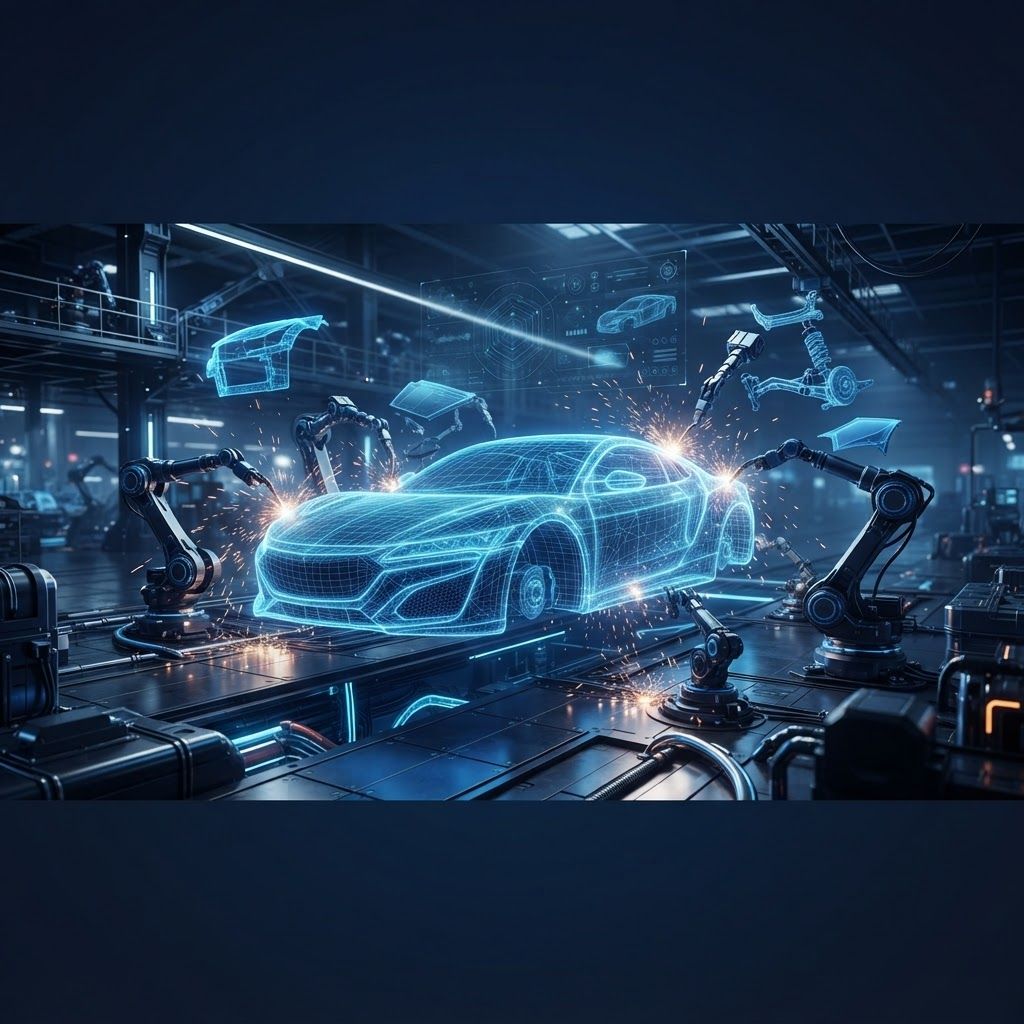
Automotive Manufacturing at the Heart of the Borough
Telford and Wrekin occupies an important position in the West Midlands automotive landscape. The borough sits within comfortable reach of the region's vehicle assembly plants and premium marques, and its industrial estates host a substantial concentration of component manufacturers, precision machinists, pressing and forming specialists, tooling houses, surface treatment providers and systems suppliers feeding those plants.
Automotive work in the borough covers an enormous range. Some businesses produce high-volume machined components measured in millions of parts per year. Others specialise in low-volume, high-complexity assemblies for premium and performance vehicles. There are prototype and development specialists working with vehicle manufacturers years ahead of production, and aftermarket producers serving replacement parts markets worldwide.
The Capabilities That Define the Sector
Precision machining is foundational. CNC turning and milling centres across the borough produce engine, transmission, braking and suspension components to tolerances measured in microns. The best operations run lights-out shifts with automated part loading, in-process gauging and statistical process control feeding back into machine adjustment automatically.
Metal forming and pressing capability covers everything from progressive die stamping of small brackets to larger structural pressings. Associated capabilities include welding and joining, both robotic and manual, along with assembly of welded sub-frames and structures.
Tooling design and manufacture is a specialism that underpins everything else. Telford has toolmakers producing press tools, injection moulds and specialised fixtures, and this capability is strategically important because tooling lead time frequently determines how quickly a new vehicle programme can reach production.
Surface treatment and finishing completes the picture, with heat treatment, plating, anodising, painting and coating operations serving both local manufacturers and the wider regional supply chain.
Quality Systems in a Demanding Sector
Automotive is arguably the most quality-disciplined manufacturing sector outside aerospace and medical devices. Suppliers work to the automotive quality management standard, which layers extensive additional requirements onto general quality management principles, including specific demands around risk analysis, control planning and continuous improvement.
The production part approval process governs how new parts are introduced. A supplier must demonstrate through documented evidence, dimensional reports, material certifications and capability studies that its process will consistently produce conforming parts before volume shipment is authorised. Failure mode and effects analysis is used systematically to identify and mitigate risks before they cause field problems.
Statistical process control runs continuously in production, with capability indices monitored on critical characteristics. Manufacturers in the borough serving tier-one and OEM customers maintain this discipline as a matter of routine, and it is one of the clearest markers separating genuine automotive suppliers from general engineering firms.
Electrification and the Sector's Transition
The shift to electric vehicles is the defining challenge and opportunity for automotive manufacturing in Telford and Wrekin. Internal combustion powertrains contain thousands of machined components that electric vehicles simply do not need. Businesses heavily weighted toward engine and transmission work have had to adapt or decline.
The manufacturers responding well have moved into areas that grow with electrification. Battery enclosure structures require large, precise, sealed assemblies with demanding thermal and structural performance. Electric drive units need housings, gear sets and cooling systems produced to fine tolerances. Power electronics require busbars, connectors, cooling plates and shielded enclosures. Thermal management systems have become far more complex than in conventional vehicles.
Lightweighting is another growth area, driving demand for aluminium machining, high-strength steel forming, composite components and mixed-material joining techniques. Businesses that invested early in these capabilities have positioned themselves well.
Interior and comfort systems have also grown in importance. As vehicles become quieter, refinement requirements rise, benefiting suppliers of acoustic materials, precision interior components and trim systems.
Automation and Digital Manufacturing
Competitive automotive manufacturing demands automation, and the leading operations in the borough have invested accordingly. Robotic machine tending, automated inspection cells with coordinate measuring machines and vision systems, automated guided vehicles moving material between processes, and integrated manufacturing execution systems tracking every part through the plant are increasingly standard.
Digital traceability is now expected rather than optional. Serialised components carry data recording the machine, tooling, operator, material lot and inspection results associated with their production. When a field issue arises, this data enables precise containment rather than blanket recall.
Location and Skills Advantages
Telford's proximity to the M54 and the wider motorway network gives direct access to vehicle plants across the Midlands and beyond, supporting the just-in-time delivery schedules automotive customers demand. The borough's industrial estates offer substantial, well-serviced premises at costs below those of the Birmingham and Coventry conurbations.
Skills are a genuine asset. Telford has a deep manufacturing engineering culture, well-developed apprenticeship provision through local colleges and training providers, and a workforce familiar with the disciplines of high-volume production. Several manufacturers run their own training academies, recognising that developing talent internally is more reliable than competing for scarce experienced staff.
Choosing an Automotive Manufacturing Partner
Verify certification and current customer approvals first. Automotive supply is difficult to enter, and a supplier already approved by relevant tier-one or OEM customers has demonstrated its systems work.
Assess capacity against your programme volumes over the full lifecycle, not just launch. Ask about capability study results on critical characteristics, on-time delivery performance and parts-per-million defect rates. Discuss how the supplier handles engineering changes, which are inevitable in automotive programmes.
Evaluate financial stability seriously. Automotive programmes run for years and involve significant tooling investment, so supplier failure mid-programme is enormously disruptive.
Final Thoughts
Automotive manufacturing in Telford and Wrekin remains a significant employer and a source of genuine engineering excellence. The businesses thriving here are those that combine rigorous quality discipline with the willingness to invest in the capabilities electrification demands. For buyers seeking capable, well-located UK automotive suppliers, the borough offers real depth.
Want your brand featured in front of decision-makers? Publish a guest post or get a link insertion in our guides through AAMAX's guest post and link insertion service.
Helpful Links
 SponsoredAAMAX — Full-Service Digital Agency
Write for Us
Share your expertise with our readers. We welcome guest contributions from industry specialists.
Pitch your idea

