

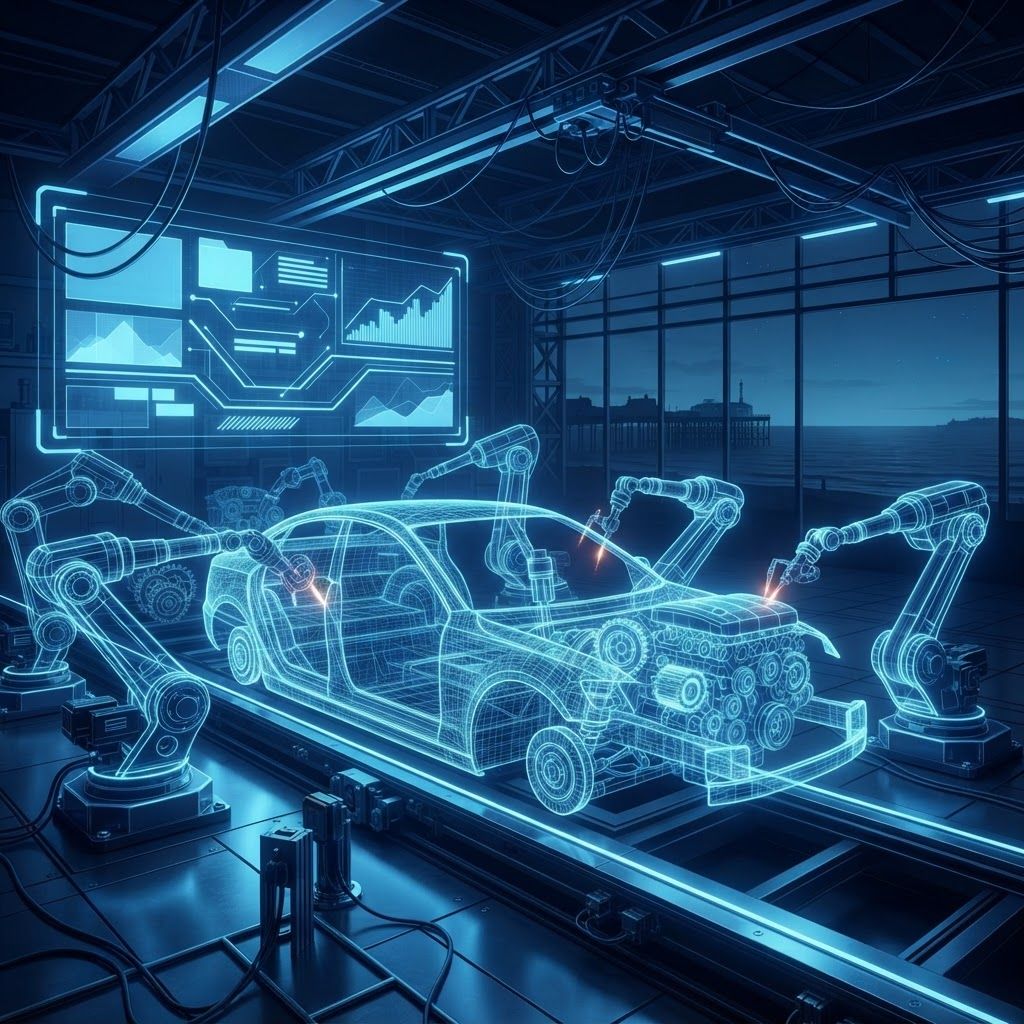
Automotive Manufacturing in South Essex
Southend-on-Sea is not home to a mass-production car plant, and understanding that immediately clarifies the local automotive picture. What the town and its surrounding industrial estates do host is a network of component manufacturers, precision machinists, specialist vehicle converters, performance engineering workshops, trim and upholstery specialists, and aftermarket parts producers. This is where a great deal of genuine automotive value is created in the United Kingdom outside the major assembly plants.
South Essex sits within reach of the wider south-east automotive supply chain, with good road links via the A127 and A13 corridors to London, the M25 and the Thames crossings, plus port access for import and export. That logistics position, combined with a skilled engineering labour pool inherited from the region's aerospace, marine and light industrial history, supports a resilient automotive cluster.
What the Local Sector Produces
Precision Components and Machining
Subcontract machining businesses supply turned and milled parts, brackets, housings, shafts, bushings and fasteners to automotive tier suppliers. Modern shops run computer numerical control turning and milling centres capable of tight tolerances and consistent repeatability, supported by coordinate measuring machine inspection.
Specialist Vehicle Conversion
Vehicle conversion is a strong UK niche and well represented across Essex. Work includes welfare and wheelchair accessible vehicle adaptation, refrigerated and insulated bodies, mobile workshops and welfare units, security and cash-in-transit vehicles, emergency service and utility fit-outs, camper and motorhome conversions, and racking systems for trade vans. Conversion requires structural engineering, electrical integration, type approval knowledge and high-quality finishing.
Performance and Motorsport Engineering
The south-east has deep motorsport roots, and workshops in the region produce performance components, roll cages, exhaust systems, suspension parts, engine builds and race preparation services. This work blends fabrication, machining, materials knowledge and testing.
Trim, Upholstery and Interiors
Automotive trim specialists produce and retrofit seating, headlining, carpets, leather interiors and bespoke finishes for classic restoration, premium retrofit and commercial fleet applications.
Electrical and Electronic Assemblies
Wiring harnesses, control modules, lighting assemblies and increasingly electric vehicle related components such as battery enclosures, charging hardware and thermal management parts are produced by local engineering firms.
Classic Vehicle Restoration and Parts Manufacture
Britain's classic car sector sustains manufacturers producing panels, trim and mechanical parts no longer available, often using traditional panel beating alongside modern scanning and fabrication techniques.
Industry Trends
Electrification is the sector's central transformation. The shift toward battery electric vehicles is reconfiguring supply chains, reducing demand for engine and exhaust components while creating opportunities in battery enclosures, busbars, high-voltage cabling, thermal systems, lightweight structures and power electronics cooling. Component manufacturers that have diversified are faring considerably better than those wholly dependent on internal combustion parts.
Lightweighting continues across all powertrains, driving interest in aluminium, high-strength steels, composites and advanced joining techniques such as structural adhesive bonding and friction stir welding.
Commercial vehicle conversion is growing strongly, supported by e-commerce logistics demand and fleet electrification. Converters must now handle high-voltage safety, altered payload calculations and different chassis characteristics on electric base vehicles.
Regulatory and approval requirements are tightening. Vehicle conversions must satisfy type approval or individual approval regimes, with growing attention to safety systems, braking, lighting and driver assistance interaction.
Digital manufacturing is becoming standard, with three-dimensional scanning for reverse engineering, additive manufacturing for jigs, fixtures and low-volume parts, and simulation used to validate structures before metal is cut.
Finally, supply chain localisation has accelerated after recent disruption, with manufacturers valuing nearby suppliers who can respond quickly to schedule changes.
Benefits of Working with Local Manufacturers
Proximity supports engineering collaboration. Prototype iterations, fit checks and first article inspections happen far faster when the supplier is a short drive away, and problems get resolved on the shop floor rather than through lengthy correspondence.
Flexibility on volume is a major advantage. Local machinists and fabricators routinely accept batch sizes that overseas mass producers would decline, making them ideal for niche vehicles, motorsport, restoration and pre-production work.
Quality traceability is clearer, with documented material certificates, inspection records and the ability to audit processes directly.
Lead time and logistics costs improve, reducing inventory requirements and the working capital tied up in stock in transit.
How to Choose an Automotive Manufacturing Partner
Verify quality accreditation appropriate to your position in the chain. Automotive-specific quality management certification is expected for tier supply, while general quality certification may suffice for aftermarket and specialist work. Ask about production part approval processes and measurement systems analysis if you are supplying original equipment programmes.
Confirm technical capability precisely: machine envelope and axis count, achievable tolerances, materials handled, welding qualifications, coating and finishing options, and inspection equipment available.
For vehicle conversion, approval competence is critical. Establish whether the converter holds relevant type approval arrangements or manages individual vehicle approval, and whether it provides the documentation required for registration and insurance. Ask about warranty implications on the base vehicle.
Assess engineering support. The best partners offer design for manufacture input, material recommendations and tooling advice rather than simply quoting to drawing.
Review capacity and resilience. Ask about machine redundancy, shift patterns, subcontract arrangements and how the supplier handles schedule fluctuation.
Discuss electrification readiness if relevant, including high-voltage training, insulation testing capability and experience with battery or charging components.
Finally, visit the facility. Cleanliness, tool control, work-in-progress organisation and staff engagement reveal more than any brochure.
Practical Advice for Buyers
Provide complete technical data: fully dimensioned drawings or model files with tolerances, material specification, surface finish requirements, quantity and schedule expectations, and any testing or certification needs. Agree inspection requirements and acceptance criteria in writing before production. For conversions, define the operational use case carefully, since payload, access requirements and duty cycle drive the engineering solution.
Final Thoughts
Automotive manufacturing around Southend-on-Sea is characterised by specialisation, precision and adaptability rather than volume. Component machining, vehicle conversion, performance engineering, trim work and increasingly electric vehicle related fabrication are all delivered by capable local businesses. For buyers needing engineering partnership, modest batch quantities and full traceability, the regional supply base offers strong advantages, provided accreditation, approval competence and technical fit are properly verified.
Want your brand featured in front of decision-makers? Publish a guest post or get a link insertion in our guides through AAMAX's guest post and link insertion service.
Helpful Links
 SponsoredAAMAX — Full-Service Digital Agency
Write for Us
Share your expertise with our readers. We welcome guest contributions from industry specialists.
Pitch your idea

