

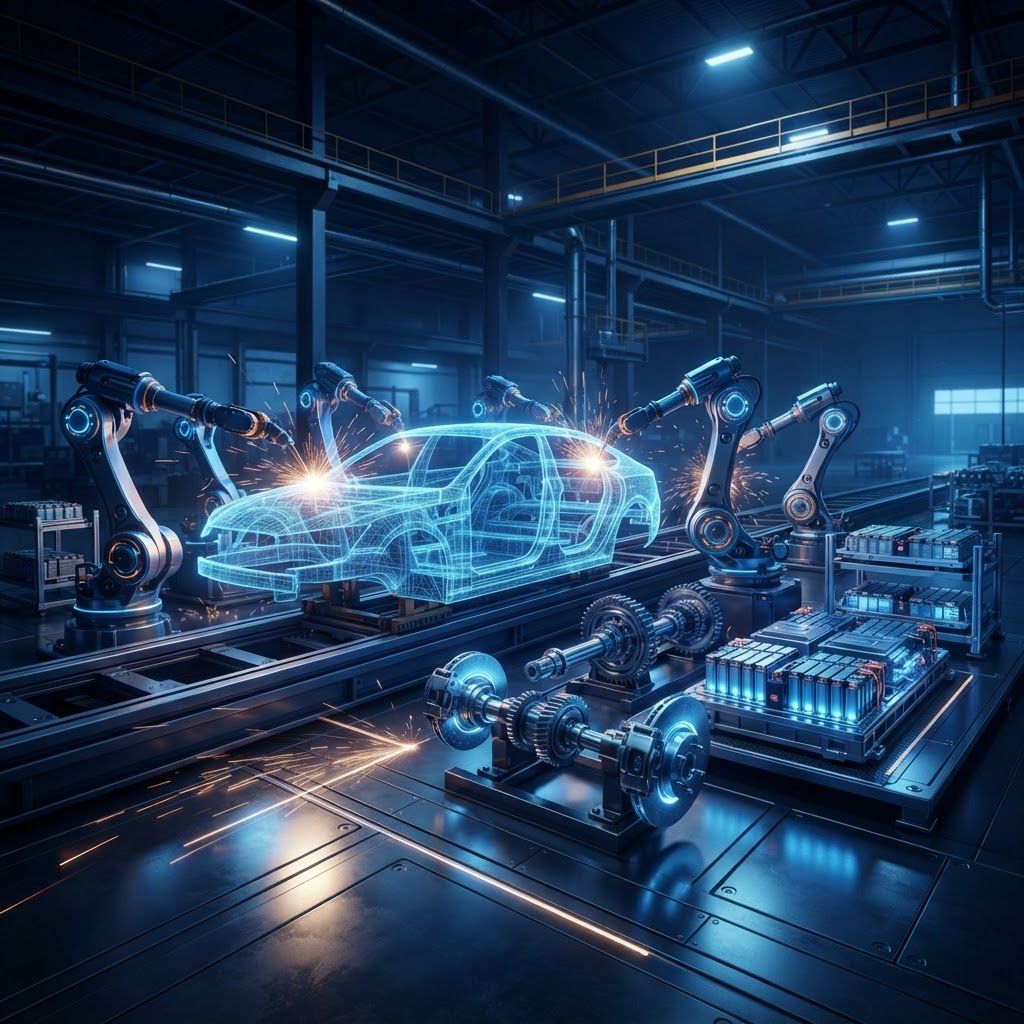
Renfrewshire's Automotive Heritage and Present Reality
Renfrewshire holds a genuinely significant place in British automotive history. The Linwood plant, opened in the early 1960s, became one of Scotland's largest manufacturing employers and produced vehicles including the Hillman Imp. Its closure in the early 1980s was a defining economic event for the county, and the site has since been redeveloped for mixed industrial and retail use.
Vehicle assembly did not return, but the engineering capability the plant helped concentrate in the area proved durable. Today Renfrewshire's automotive sector consists of component manufacturers, precision machinists, tooling specialists, electrical and electronic suppliers, aftermarket producers and engineering consultancies. These businesses supply UK and European vehicle manufacturers, commercial vehicle builders, bus and coach manufacturers, motorsport teams and the fast-growing electric vehicle sector.
What Local Automotive Businesses Produce
Local output covers machined engine, transmission and chassis components, pressed and fabricated metal parts, injection moulded interior and under-bonnet plastics, wiring harnesses and electrical assemblies, battery module components and thermal management parts, brake and suspension components, tooling, jigs and fixtures for production lines, commercial vehicle bodywork and conversions, and testing and validation services.
The Top 10 Automotive Manufacturers in Renfrewshire
1. Clyde Automotive Components
A precision machining and assembly business supplying safety-critical components to vehicle manufacturers and tier one suppliers. It operates to automotive quality management standards with statistical process control and full traceability, and is known for consistent delivery performance on scheduled call-off contracts.
2. Linwood Precision Engineering
Occupying part of the county's traditional automotive heartland, this company machines transmission, driveline and chassis components in volumes suited to commercial vehicle and specialist manufacturers. Its multi-axis machining capability handles complex geometries in a single setup, improving both accuracy and cost.
3. Paisley Vehicle Systems
Manufacturing electrical and electronic assemblies for vehicles, including wiring harnesses, control modules and lighting assemblies, this business has expanded into electric vehicle applications such as high-voltage cabling and battery monitoring hardware.
4. Renfrew Tooling & Fixtures
Producing press tools, injection moulds, welding jigs and assembly fixtures, this company supports other manufacturers rather than supplying vehicles directly. Tooling quality determines production consistency, making this a foundational capability within the local supply chain.
5. Erskine Commercial Vehicle Conversions
Specialising in van and truck conversions, this business builds refrigerated bodies, welfare units, specialist service vehicles and accessibility conversions. Its work involves structural fabrication, electrical systems integration and compliance with vehicle type approval requirements.
6. Gleniffer Brake & Suspension Products
Manufacturing and remanufacturing brake components, suspension parts and related assemblies for aftermarket and specialist applications, this company combines production with technical support for fitment and performance questions.
7. Johnstone Automotive Plastics
An injection moulding business producing interior trim, clips, housings and under-bonnet components, with in-house tool maintenance and material expertise covering engineering polymers and glass-filled compounds. Its focus on dimensional stability suits close-tolerance assembly applications.
8. Bishopton EV Systems
Focused entirely on electric vehicle technology, this business produces battery module hardware, thermal management components, high-voltage connection systems and charging equipment assemblies. It represents the clearest example of local automotive engineering repositioning for electrification.
9. Braehead Motorsport Engineering
Serving competition and performance applications, this company undertakes bespoke component manufacture, chassis fabrication, roll cage construction and rapid prototyping. Motorsport work demands short lead times and iterative design, and its flexibility supports that pattern.
10. Lochwinnoch Automotive Testing
Providing component durability testing, vibration and thermal cycling, materials analysis and failure investigation, this business supports validation programmes for manufacturers and suppliers. Independent test evidence is increasingly required by customers before production approval.
Quality Standards and Supply Chain Tiering
Automotive supply operates through a strict tier structure. Vehicle manufacturers sit at the top, tier one suppliers deliver complete systems, tier two suppliers provide components to tier one, and tier three suppliers offer raw materials and basic processing. Understanding where a business sits clarifies what it can realistically deliver.
Quality expectations are correspondingly rigorous. Automotive-specific quality management certification, production part approval processes, failure mode and effects analysis, measurement systems analysis and statistical process control are standard requirements rather than optional extras. Suppliers unfamiliar with these disciplines struggle to enter the sector regardless of their machining capability.
Electrification and Its Consequences
The transition to electric vehicles is the most significant structural change the industry has faced in a century, and its effects on the supply chain are uneven. Demand is falling for engine, fuel system, exhaust and conventional transmission components. Demand is rising sharply for battery enclosures and modules, thermal management systems, power electronics, high-voltage cabling and connectors, lightweight structures, and electric drive unit components.
Renfrewshire suppliers with transferable precision machining, fabrication and electrical assembly capability are adapting successfully. Those tied exclusively to internal combustion components face a harder path, and the more forward-looking businesses have already diversified into adjacent sectors such as rail, renewables and industrial equipment.
Additional Trends
Lightweighting continues across all powertrains, driving interest in aluminium, high-strength steel and composite components. Software-defined vehicles are increasing the electronics and connectivity content per vehicle. Circularity requirements are pushing remanufacturing and material recovery up the agenda. Nearshoring, prompted by supply disruption and freight cost volatility, is creating opportunities for UK suppliers that can demonstrate reliability.
How to Select an Automotive Supplier
Begin with certification and audit history, as automotive customers will require evidence. Assess capacity realistically, including machine availability, shift patterns and whether the supplier can absorb volume increases. Examine delivery performance data rather than assurances, since schedule reliability is valued above almost everything else in this sector.
Also consider engineering support. Suppliers who contribute design for manufacture input, propose material alternatives and identify tolerance issues before production reduce total programme cost far more than a marginally lower piece price.
Final Thoughts
Renfrewshire's automotive sector has outlived the plant that once defined it by specialising in components, tooling, electrical systems and engineering services. The ten businesses above span machining, plastics, electrical assembly, EV systems, conversions, motorsport and testing. Their adaptability through electrification will determine the sector's next chapter, and the early evidence is encouraging.
Want your brand featured in front of decision-makers? Publish a guest post or get a link insertion in our guides through AAMAX's guest post and link insertion service.
Helpful Links
 SponsoredAAMAX — Full-Service Digital Agency
Write for Us
Share your expertise with our readers. We welcome guest contributions from industry specialists.
Pitch your idea

