

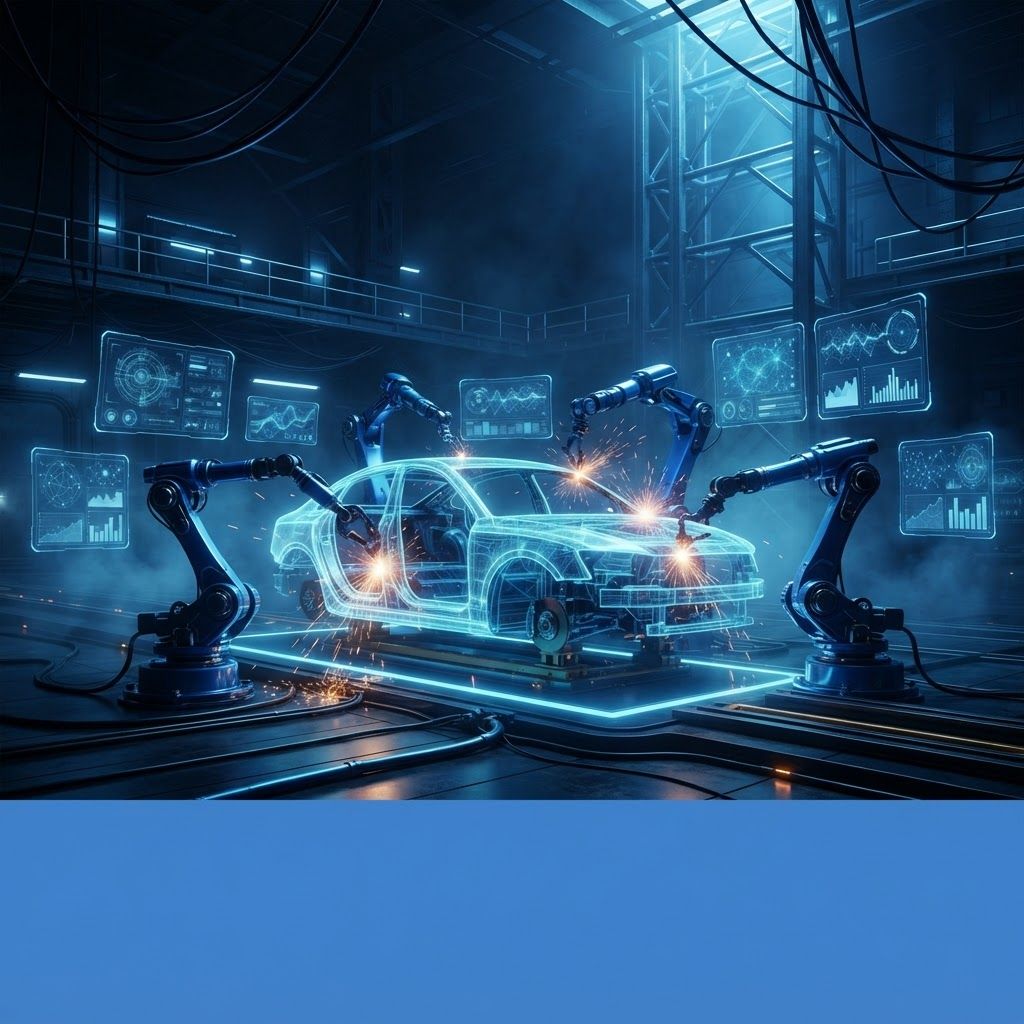
Halton Within the North West Automotive Corridor
The North West of England remains one of the United Kingdom's most important vehicle manufacturing regions, with major assembly plants within a short drive of Halton in every direction. That geography has made the borough a natural home for tier two and tier three suppliers, the companies producing the components, sub-assemblies, tooling and engineering services that vehicle makers depend upon.
Runcorn and Widnes offer exactly what automotive suppliers require: industrial premises capable of housing presses and moulding machinery, motorway access for just-in-time delivery, and a labour market with genuine manufacturing experience. The sector here is less visible than a final assembly plant but no less consequential to the regional economy.
How the Automotive Supply Chain Works
Vehicle manufacturing operates through tiers. A tier one supplier delivers complete systems directly to the vehicle maker, such as a seat assembly or braking module. Tier two firms supply components to tier one companies, and tier three provides raw materials and basic processing. Most Halton businesses operate at tiers two and three, alongside specialist service providers offering tooling, testing, surface treatment and logistics.
Quality expectations are exacting throughout. Automotive supply typically requires certification to sector-specific quality management standards, documented production part approval processes, and statistical process control demonstrating consistent capability rather than merely acceptable samples.
The Ten Best Automotive Manufacturers in Halton
1. Mersey Automotive Components
Mersey Automotive Components is the borough's most substantial automotive supplier, producing pressed metal components and welded sub-assemblies for vehicle structures and chassis systems. The company operates progression tooling, robotic welding cells and in-line inspection, and holds the quality approvals required for direct supply to tier one customers.
2. Runcorn Precision Engineering
Runcorn Precision Engineering machines high-tolerance components for powertrain, steering and braking applications. Its multi-axis machining centres and coordinate measuring capability allow the firm to hold tolerances measured in microns, and its process documentation satisfies the traceability demands of safety-critical parts.
3. Widnes Polymer Automotive
This injection moulding specialist produces interior trim, clips, housings and under-bonnet components. Widnes Polymer Automotive works with engineering polymers selected for heat resistance and dimensional stability, and offers overmoulding and insert moulding for parts combining plastic and metal elements.
4. Halton Electric Vehicle Systems
Halton Electric Vehicle Systems has positioned itself squarely in the electrification transition, manufacturing battery module housings, busbars, thermal management components and high-voltage cable assemblies. The specialist knowledge required for high-voltage work has made the company an increasingly sought-after partner.
5. Astmoor Tooling and Dies
Astmoor Tooling and Dies designs and manufactures the press tools, moulds and fixtures on which volume production depends. Tooling quality determines part quality, and the company's reputation for durable, well-engineered tools has earned it work from manufacturers across the region.
6. Silver Jubilee Vehicle Engineering
Operating in low-volume and specialist vehicle work, Silver Jubilee Vehicle Engineering carries out conversions, bodywork fabrication and bespoke builds for commercial and emergency service fleets. Its ability to engineer one-off solutions complements the volume producers around it.
7. Halebank Surface Treatments
Halebank Surface Treatments provides plating, painting, powder coating and corrosion protection for automotive components. Finish quality and corrosion performance are heavily specified in the sector, and the company maintains the testing regimes needed to demonstrate compliance.
8. Ditton Automotive Electronics
Ditton Automotive Electronics manufactures control modules, sensor assemblies and wiring harnesses for vehicle and off-highway applications. Its work encompasses environmental qualification, electromagnetic compatibility testing and the rigorous validation that vehicle electronics demand.
9. Weaver Valley Commercial Vehicles
Focused on trucks, trailers and specialist commercial vehicles, Weaver Valley Commercial Vehicles produces bodywork, load-handling equipment and chassis modifications. Fleet operators value its understanding of operational durability and whole-life maintenance considerations.
10. Norton Priory Testing Services
Completing the list, Norton Priory Testing Services provides validation and testing for automotive components, including fatigue, vibration, thermal cycling and materials analysis. Independent verification is a prerequisite for supply approval, and local access to such facilities shortens development timescales considerably.
Electrification and Its Consequences
No force is reshaping automotive manufacturing more profoundly than the shift to electric drivetrains. An electric vehicle contains far fewer moving parts than one with an internal combustion engine, eliminating demand for exhaust systems, fuel delivery components and complex multi-speed transmissions. Suppliers built around those products face an existential challenge.
Yet new opportunities are substantial. Battery enclosures, thermal management systems, high-voltage distribution, power electronics and lightweight structures all represent growing markets. Halton companies that have invested in high-voltage competence, aluminium and composite processing, and thermal engineering are finding demand outstripping their capacity.
Lightweighting is a parallel theme. Because battery packs are heavy, manufacturers pursue weight reduction aggressively elsewhere in the vehicle, driving interest in aluminium, high-strength steels and polymer composites.
Choosing an Automotive Supplier
Verify quality certification appropriate to the tier and application. Ask about capacity headroom, since automotive schedules can escalate rapidly. Review problem resolution processes and how corrective actions are documented. Where components are safety related, confirm the supplier understands the associated validation and traceability obligations.
Conclusion
Halton's automotive manufacturers form a resilient and adaptable part of the regional supply chain. Those profiled here have combined established engineering discipline with genuine investment in the technologies the next generation of vehicles requires.
Want your brand featured in front of decision-makers? Publish a guest post or get a link insertion in our guides through AAMAX's guest post and link insertion service.
Helpful Links
 SponsoredAAMAX — Full-Service Digital Agency
Write for Us
Share your expertise with our readers. We welcome guest contributions from industry specialists.
Pitch your idea

