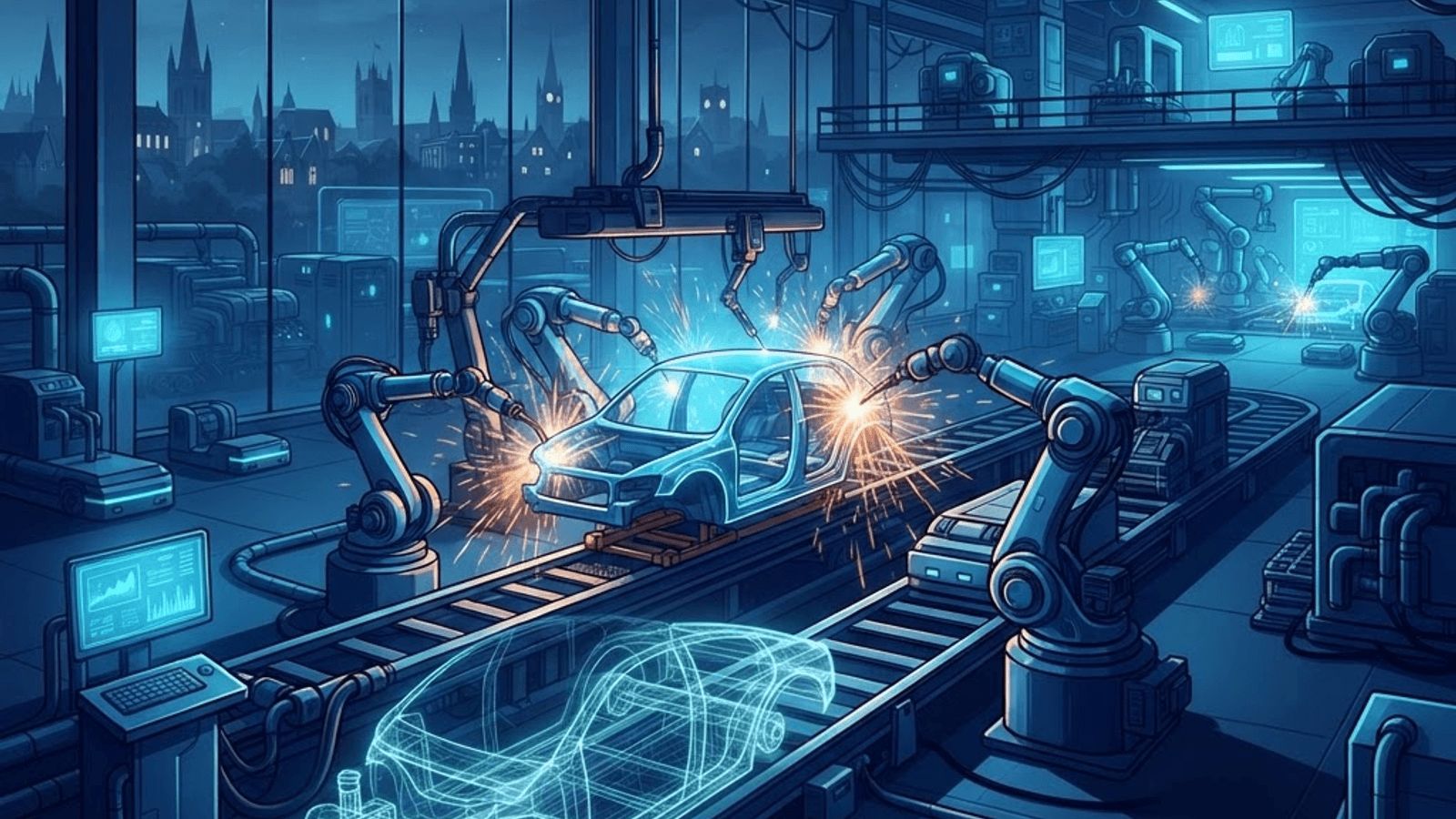
Gedling's Place in the East Midlands Automotive Supply Chain
The East Midlands has been a centre of British vehicle manufacturing for well over a century, and Gedling has long played a supporting role in that story. While the borough is not home to a large vehicle assembly plant, it hosts a dense network of component manufacturers, machining specialists, conversion companies and aftermarket producers that feed into the wider regional supply chain. Derby, Burton and the Midlands assembly plants are all within comfortable logistics range, and Gedling firms routinely ship tier-two and tier-three components into those operations.
What makes the borough distinctive is the mix. Alongside traditional metal-cutting and pressing businesses, you will find commercial vehicle body builders, specialist trailer and conversion engineers, performance and restoration workshops that manufacture their own parts, and a growing group of firms turning their attention to electric vehicle components, battery enclosures and charging infrastructure hardware.
What Automotive Manufacturing Looks Like Locally
Typical Gedling output includes CNC-machined brackets, housings and shafts; pressed and fabricated steel components; welded subframes and chassis parts; injection-moulded trim and functional plastic components; wiring harnesses; and fully finished vehicle conversions such as welfare units, refrigerated bodies and accessible transport. A number of businesses also produce aftermarket and motorsport parts, an area where the region's engineering heritage gives it real credibility.
Volumes vary widely. Some firms run repeat annual contracts measured in hundreds of thousands of pieces, while others specialise in batches of fifty or in one-off builds. This range is a strength: a customer can often find both a prototype partner and a production partner within a few miles.
The Top 10 Automotive Manufacturers Serving Gedling
1. Gedling Automotive Components
A precision machining business supplying turned and milled components into tier-one automotive suppliers. Known for statistical process control, full PPAP documentation and the kind of dimensional consistency that automotive customers demand as standard.
2. Colwick Vehicle Engineering
Specialists in commercial vehicle conversions, including welfare vehicles, tipper bodies and bespoke workshop vans. The company handles chassis modification, body build, electrical fit-out and type approval as a complete package.
3. Netherfield Pressings
A metal pressing and fabrication operation producing brackets, panels, heat shields and structural components. Their toolroom capability allows press tools to be designed, built and maintained in-house, shortening lead times for new parts.
4. Arnold Motorsport Fabrication
Focused on performance and competition work, manufacturing roll cages, suspension components, exhaust systems and lightweight chassis parts. Precision TIG welding and a strong understanding of motorsport regulations define their output.
5. Carlton Trailer and Towing
Manufactures and refurbishes commercial trailers, plant transporters and towing equipment. The business combines heavy fabrication with hydraulics, braking and lighting systems integration.
6. Mapperley EV Systems
One of the borough's newer entrants, concentrating on electric vehicle support hardware: battery enclosures, charging unit housings, high-voltage cable assemblies and thermal management components.
7. Burton Joyce Rubber and Seals
Produces moulded rubber components, gaskets, bushes and vibration isolators for automotive and off-highway applications. Material formulation expertise is their principal differentiator.
8. Lambley Auto Plastics
An injection moulding specialist producing interior trim, clips, housings and functional plastic parts, with in-house tool maintenance and increasing use of recycled and bio-based polymer grades.
9. Ravenshead Classic Restorations
A restoration engineering firm that manufactures obsolete and discontinued parts to original specification, using reverse engineering, scanning and traditional panel-beating craft alongside modern machining.
10. Gedling Surface Treatments
Provides powder coating, e-coating, phosphating and specialist paint finishing for automotive components. As a finishing partner to many other local manufacturers, the firm is an essential node in the borough's supply network.
Electrification and the Changing Shape of Demand
The transition to battery electric vehicles is the single largest force acting on automotive manufacturing, and its effects are already visible in Gedling. Demand for engine-related machining, exhaust fabrication and fuel system components is gradually declining, while demand for battery enclosures, busbars, high-voltage connectors, thermal management parts and lightweight structural components is rising sharply.
Local firms are responding in different ways. Some are diversifying into adjacent sectors such as rail, agricultural machinery and renewable energy, where their metalworking and machining skills transfer directly. Others are investing in new capability, particularly aluminium welding, composite bonding and high-voltage electrical assembly. The businesses that manage this transition well tend to be those that started early and treated it as product development rather than crisis management.
Quality Standards and What They Mean for Buyers
Automotive customers operate to some of the most demanding quality regimes in manufacturing. IATF 16949 is the sector-specific quality management standard and signals that a supplier has the process discipline needed for tier-one work. Beyond certification, buyers should expect production part approval process documentation, control plans, failure mode and effects analysis, measurement systems analysis and full material traceability.
For lower-tier and aftermarket work, ISO 9001 with strong internal inspection may be sufficient. The key is matching the level of quality assurance to the risk profile of the part. A cosmetic trim clip does not need the same regime as a braking system bracket, and paying for unnecessary documentation adds cost without adding value.
Choosing an Automotive Manufacturing Partner in Gedling
Begin by defining volume, tolerance and compliance requirements clearly, because these three variables will eliminate most of the shortlist immediately. Then look at capacity headroom; a supplier running at full utilisation may deliver your first order perfectly and struggle with the second.
Visit the facility. Cleanliness, organisation, calibration labelling and how operators talk about quality tell you more in twenty minutes than any brochure. Ask about single-source risks in their own supply chain, particularly for raw material and surface finishing.
Finally, consider the relationship over the product lifecycle. Automotive programmes run for years, and the ability to support engineering changes, manage obsolescence and hold service stock after end of production is often what separates a good supplier from an excellent one.
Looking Ahead
Gedling's automotive manufacturers face genuine disruption but also genuine opportunity. The skills that produced combustion engine components transfer readily to electrification hardware, rail, aerospace and energy infrastructure. Firms investing in new processes, apprenticeships and diversified customer bases look well placed to remain a valuable part of the East Midlands supply chain for decades to come.
Want your brand featured in front of decision-makers? Publish a guest post or get a link insertion in our guides through AAMAX's guest post and link insertion service.
Helpful Links
 SponsoredAAMAX — Full-Service Digital Agency
Write for Us
Share your expertise with our readers. We welcome guest contributions from industry specialists.
Pitch your idea