

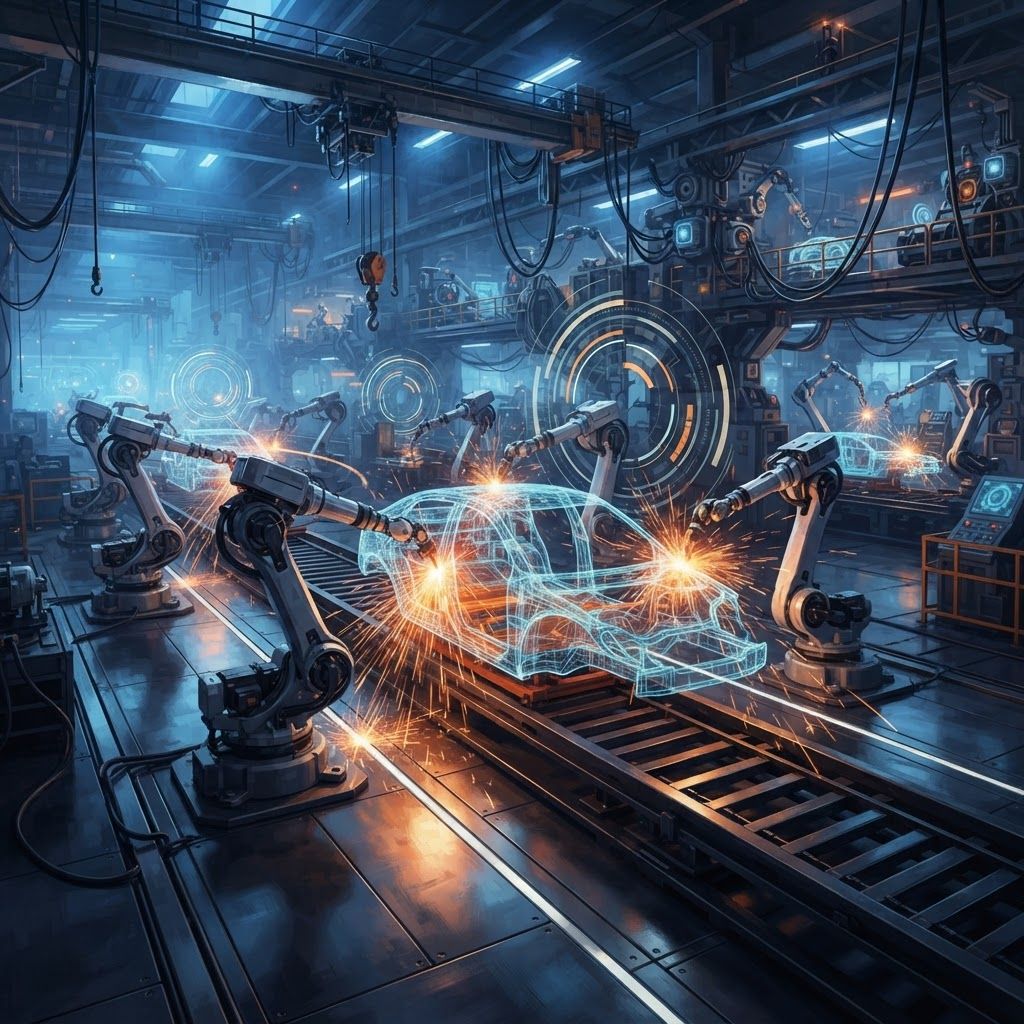
An Automotive Heritage Few Expect
Mention Scottish automotive manufacturing and most people think of the central belt, yet Dumfries has a claim that predates almost all of it. The town was home to Arrol-Johnston, one of the earliest motor manufacturers in Britain, whose Heathhall factory was among the first purpose-built reinforced concrete car plants in Europe. That building still stands, a physical reminder that vehicle production in this region is not a modern novelty.
The plant later passed through several industrial lives, including a long period producing rubber components. That thread, engineering, moulding and precision component manufacture for the vehicle industry, has continued in various forms to the present day. Dumfries and Galloway today is not a place of vast assembly lines, but it hosts component manufacturing, specialist vehicle building, conversion, bodywork and a strong engineering services base.
How Automotive Manufacturing Works in a Rural Region
Rural automotive manufacturing follows a different logic from volume car production. Success depends on specialisation rather than scale. Regional firms typically occupy one of four niches: supplying components into larger supply chains, building or converting specialist vehicles, providing precision engineering and fabrication to the sector, or restoring and remanufacturing.
Each niche suits the area. Land is affordable, industrial units are available, and the workforce carries genuine mechanical and fabrication skills developed through agriculture, forestry and marine work. Proximity to the M74 and M6 corridor also matters, giving direct access to English and central Scottish markets.
Leading Automotive Manufacturers and Specialists
Gates Corporation operates a long-established manufacturing presence in Dumfries producing power transmission and fluid power products. Belts, hoses and related components made in the region feed into automotive and industrial supply chains globally, making it one of the most significant manufacturing employers in the area.
Penman Engineering has a storied history in Dumfries building specialist and defence vehicles, trailers and armoured bodies. The company's legacy established a deep pool of heavy fabrication and vehicle body skills locally.
Alexander Dennis, Scotland's bus and coach manufacturer, sits within reach of the region and draws on southern Scottish suppliers for fabrication, trim and component work, as well as employing people who commute from the region.
Specialist vehicle converters across Dumfries and Galloway produce livestock transporters, tipper bodies, welfare units, mobile workshops and forestry vehicles. Agriculture and forestry create constant demand for vehicles adapted well beyond factory specification.
Horsebox and livestock trailer builders serve the region's substantial equestrian and farming communities, producing bespoke units built to withstand heavy use on rough tracks and in wet conditions.
Motorhome and campervan conversion workshops have grown rapidly with the popularity of the South West Coastal 300 touring route. These firms build insulated, fitted-out leisure vehicles combining joinery, electrical systems, plumbing and upholstery.
Classic car restoration specialists operate throughout the region, undertaking chassis repair, panel fabrication, paintwork and mechanical rebuilds. The skills involved, particularly hand-forming panels and metal finishing, are genuinely rare and command international clients.
Precision engineering and machining businesses supply turned and milled components to automotive and industrial customers, offering CNC capability, prototyping and small batch production.
Commercial vehicle bodybuilders and repairers maintain the region's haulage fleets, fabricating and repairing bodies, curtainsiders, tail lifts and refrigerated units.
Electric vehicle conversion and charging infrastructure specialists represent the newest entrants, retrofitting classic vehicles with electric drivetrains and installing depot and destination charging for local fleets and tourism businesses.
The Electrification Shift
The transition to electric vehicles is reshaping the automotive supply chain profoundly, and regional manufacturers are adapting. Internal combustion engines contain thousands of moving parts; electric drivetrains contain far fewer. Suppliers whose products depend on engines face structural decline, while those making structural components, thermal management systems, cabling, seals and interior parts often find demand steady or growing.
For Dumfries and Galloway, electrification also brings opportunity on the infrastructure side. Charging points at hotels, visitor attractions, car parks and business premises require installation, and the region's abundant renewable generation makes a compelling case for local clean charging.
Fleet electrification is another live issue. Council vehicles, delivery vans and service fleets are transitioning, and depots need charging infrastructure, grid connection upgrades and maintenance capability that local engineering firms are well placed to provide.
Skills and Workforce
The sector's biggest constraint is people. Welding, fabrication, auto electrics, vehicle diagnostics and CNC machining are all in demand, and the regional college network offers relevant apprenticeship pathways. Employers that invest in training rather than competing for a fixed pool of experienced staff tend to fare better.
High voltage systems training is increasingly essential. Working safely on electric and hybrid vehicles requires specific qualification, and workshops without it cannot service a growing share of the vehicle parc.
Choosing a Manufacturer or Converter
If you are commissioning a specialist vehicle or conversion, check type approval arrangements carefully, since vehicles modified beyond certain thresholds require individual approval before registration. Ask to see completed examples and, ideally, speak to previous customers about durability after a few winters of use.
Confirm warranty terms on both the base vehicle and the conversion, as manufacturers sometimes limit cover where modifications have been made. For component sourcing, verify quality accreditation and ask about traceability, which matters increasingly in automotive supply chains.
Final Thoughts
Automotive manufacturing in Dumfries and Galloway is specialised, practical and surprisingly deep-rooted. From a globally connected component plant in Dumfries to trailer builders, converters and restoration workshops scattered across the region, there is real capability here. As electrification reshapes the industry, the firms that combine traditional fabrication skill with new electrical competence look best placed to thrive.
Want your brand featured in front of decision-makers? Publish a guest post or get a link insertion in our guides through AAMAX's guest post and link insertion service.
Helpful Links
 SponsoredAAMAX — Full-Service Digital Agency
Write for Us
Share your expertise with our readers. We welcome guest contributions from industry specialists.
Pitch your idea

