

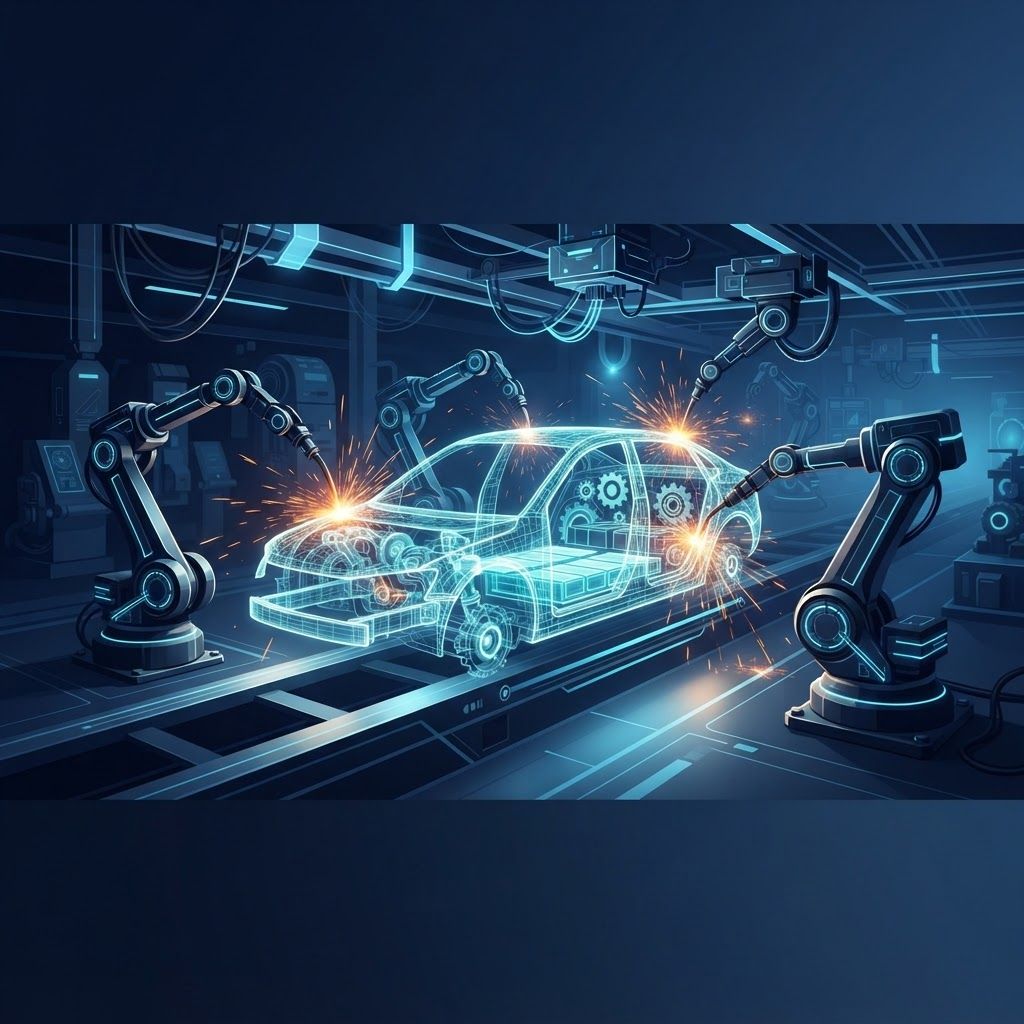
Automotive Manufacturing in Bury
The North West has a long automotive tradition, and while final vehicle assembly happens elsewhere, the supply chain reaches deep into towns like Bury. Component machining, pressings, trim, wiring, tooling, testing and specialist vehicle conversion all take place in and around the borough, supported by engineering skills developed across generations of industrial work.
The sector is currently undergoing its most significant change since mass production began. Electrification is removing entire component categories while creating others, and suppliers that have anticipated this shift are securing positions in a restructured supply chain.
Where Bury Fits in the Supply Chain
Tier two and tier three suppliers dominate locally. These businesses supply components and sub-assemblies to larger tier one integrators rather than directly to vehicle manufacturers. Precision machining, fabrication, surface treatment and assembly form the bulk of activity.
Aftermarket and specialist vehicle work is the second major strand. Commercial vehicle conversion, refrigeration units, access equipment, livery and fitting-out serve fleet operators across the region, and this segment is less exposed to the volatility of original equipment production schedules.
Tooling and engineering services complete the picture, with local firms producing jigs, fixtures, press tools and prototype parts that support production elsewhere.
The Top 10 Automotive Manufacturers in Bury
1. Irwell Precision Components machines engine, transmission and chassis parts to automotive tolerances. Statistical process control and full dimensional traceability support its position within demanding supply chains.
2. Bury Vehicle Conversions specialises in commercial vehicle adaptation, including welfare units, mobile workshops, refrigerated bodies and accessible vehicle modification, working to type approval requirements.
3. Northgate Automotive Pressings produces sheet metal pressings, brackets and structural components using progression tooling, with in-house tool maintenance supporting consistent output over long production runs.
4. Radcliffe Wiring Systems manufactures vehicle harnesses and electrical assemblies, an area of growing complexity as vehicles incorporate more sensors, control units and high-voltage systems.
5. Elton EV Systems focuses on electric vehicle components, including battery module assembly, thermal management parts and charging equipment, representing the sector's clearest growth area.
6. Whitefield Automotive Trim produces interior components, seating parts and moulded trim, combining injection moulding with textile and foam processing capability.
7. Tottington Tooling Engineering designs and manufactures press tools, jigs and fixtures for automotive production, supporting both new programme launches and maintenance of existing tooling assets.
8. Prestwich Surface Treatments provides coating, plating, anodising and paint finishing for automotive components, with corrosion testing to verify performance against manufacturer specifications.
9. Ramsbottom Motorsport Engineering serves competition and performance markets with bespoke fabrication, roll cages, suspension components and lightweight structures, where low volume and high specification are the norm.
10. Chesham Automotive Testing offers component validation including vibration, thermal cycling, durability and materials testing, helping suppliers demonstrate compliance before production approval.
Quality Standards and Requirements
Automotive supply operates under exacting quality frameworks. Sector-specific quality management certification is effectively mandatory for original equipment supply, and the production part approval process requires suppliers to demonstrate capability before volume shipment begins.
Traceability expectations are stringent. Suppliers must be able to identify which material batch and which process parameters produced a given part, enabling targeted containment if a defect emerges. This documentation discipline distinguishes automotive work from general engineering.
Continuous improvement is contractually embedded, with customers typically expecting annual cost reductions offset by productivity gains. Suppliers must therefore invest continually in process efficiency simply to maintain margin.
Electrification and Its Consequences
The transition to electric powertrains eliminates demand for exhaust systems, fuel injection, gearboxes with many speeds and numerous engine components. Suppliers concentrated in these areas face structural decline unless they diversify.
New opportunities are substantial. Battery enclosures, thermal management systems, high-voltage cabling, power electronics housings, lightweight structures and charging infrastructure all require manufacture. Several Bury businesses have repositioned successfully by applying existing metalworking and assembly skills to these products.
Lightweighting has become a design priority because vehicle mass directly affects range. This favours aluminium, composites and optimised structures, driving investment in different joining and forming processes than steel-focused suppliers have traditionally used.
Choosing an Automotive Supplier
Verify certification and approval status for your customer tier. Ask about capacity, current customer mix and financial stability, since supply chain interruption from a supplier failure is costly and disruptive.
Assess engineering capability, not just manufacturing. Suppliers able to contribute to design for manufacture reduce cost and lead time, and are more valuable partners than those simply executing drawings.
Final Thoughts
Automotive manufacturing in Bury reflects the sector's broader transition: established component and conversion businesses alongside firms building capability in electrification. The engineering skills base remains strong, and suppliers that combine automotive quality discipline with willingness to adapt are well placed for the decade ahead.
Skills and Investment in the Local Sector
Automotive suppliers in Bury have invested substantially in apprenticeship and training programmes, recognising that the technical skills required are not readily available on the open market. High-voltage safety training, in particular, has become essential as electrified components enter production.
Capital investment has followed a similar pattern. Aluminium welding, adhesive bonding, precision measurement and automated inspection all require equipment that traditional steel-focused shops did not hold. Firms that invested ahead of demand have found themselves well positioned as programmes transitioned.
Collaboration with regional universities and technology centres has supported this, providing access to expertise and testing facilities that individual small manufacturers could not justify independently.
Want your brand featured in front of decision-makers? Publish a guest post or get a link insertion in our guides through AAMAX's guest post and link insertion service.
Helpful Links
 SponsoredAAMAX — Full-Service Digital Agency
Write for Us
Share your expertise with our readers. We welcome guest contributions from industry specialists.
Pitch your idea

