

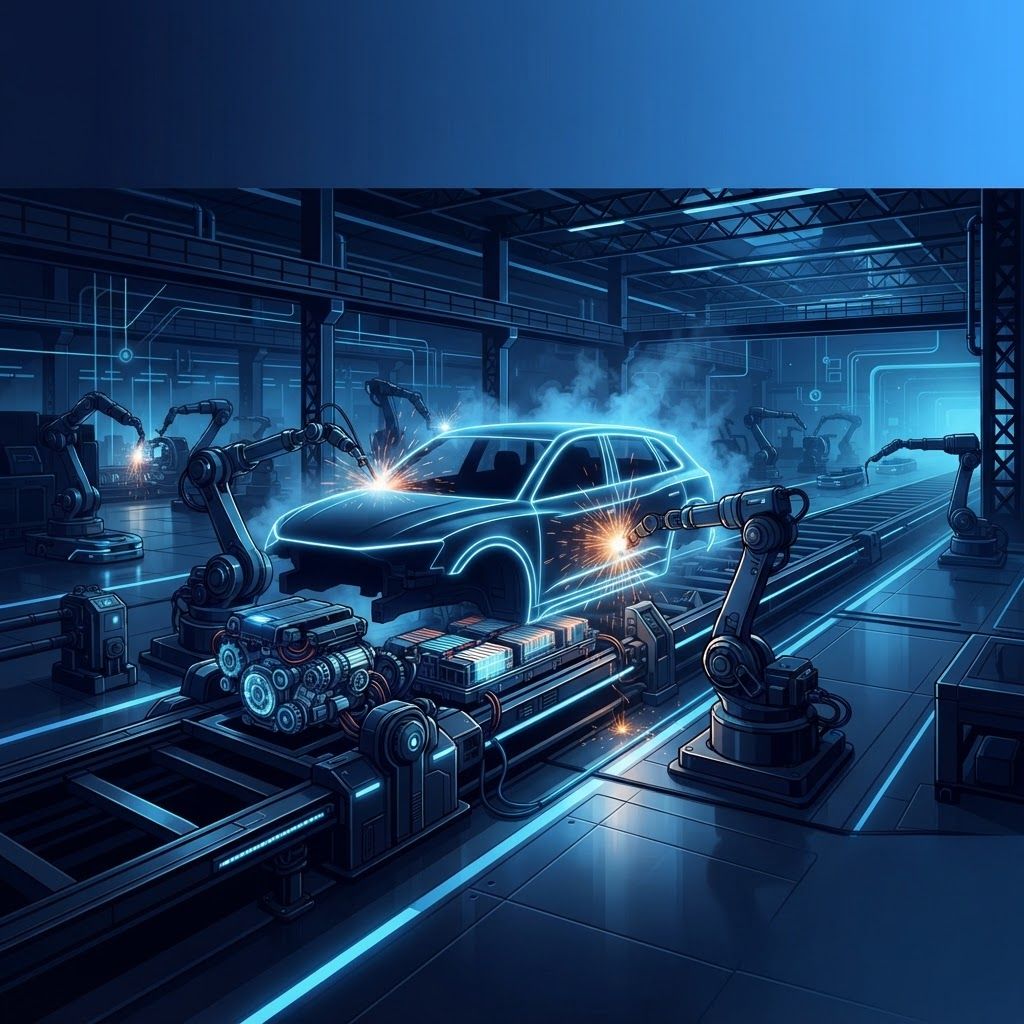
Bridgend and the Automotive Industry
For three decades Bridgend was synonymous with engine manufacturing. The large plant on the edge of town produced petrol engines at scale for global vehicle programmes and employed thousands of people directly, while supporting a dense network of local suppliers, logistics operators and service businesses. Its closure marked a genuine turning point for the county borough and prompted a concerted effort to repurpose facilities and retain engineering skills in the area.
That effort has borne fruit. The site has attracted new occupiers focused on advanced manufacturing and battery-related activity, and the wider Welsh automotive sector continues to employ a substantial workforce across component manufacture, specialist vehicles, engineering services and aftermarket operations. Bridgend's position on the M4, its established industrial estates and its pool of experienced production and maintenance engineers remain real competitive advantages.
Automotive Businesses in and Around Bridgend
INEOS Automotive has established a significant presence in Bridgend, using facilities in the area in connection with its vehicle programme and bringing renewed automotive manufacturing activity to the town.
Aston Martin Lagonda operates its sports utility vehicle production at St Athan in the Vale of Glamorgan, a short distance from Bridgend, drawing on the regional engineering workforce and supply base.
Riversimple, based in Mid Wales, develops hydrogen fuel cell vehicles and represents the innovative end of Welsh automotive engineering.
Calsonic Kansei and comparable tier one component manufacturers operating in South Wales supply exhaust systems, thermal management components and structural parts into vehicle assembly plants across the United Kingdom and Europe.
Schaeffler and similar precision component producers maintain manufacturing in Wales supplying bearings, clutches and transmission components to global automotive customers.
Precision machining and pressing businesses on Bridgend industrial estates produce brackets, housings, fasteners and machined components to automotive quality standards for tier one and tier two customers.
Wiring harness and electrical assembly suppliers in the county borough manufacture looms and connector assemblies, an area of growing importance as vehicle electrical architecture becomes more complex.
Specialist vehicle converters and bodybuilders in the region adapt vans and chassis into welfare vehicles, refrigerated units, tippers and emergency service vehicles.
Automotive engineering consultancies and test facilities across South Wales provide design, simulation, prototyping and validation services to manufacturers developing new components and systems.
Remanufacturing and aftermarket specialists around Bridgend rebuild engines, gearboxes, turbochargers and electronic control units, extending component life and supporting the circular economy in automotive parts.
The Shift to Electrification
The transition from internal combustion to electric propulsion is the defining change facing the sector. It alters the component mix fundamentally: electric vehicles contain far fewer moving parts, no exhaust system, no conventional gearbox and no fuel injection, but require battery packs, power electronics, electric motors, thermal management systems and substantially more sophisticated software.
For suppliers, this is both threat and opportunity. Businesses whose products serve only combustion engines face a shrinking market, while those able to pivot into battery enclosures, busbars, cooling systems, high-voltage cabling and lightweight structures can access growing demand. South Wales is particularly well placed on the power electronics side, given the compound semiconductor cluster developing silicon carbide and gallium nitride devices used in vehicle inverters and chargers.
Lightweighting is another consequential trend. Battery mass drives demand for aluminium structures, composite panels and optimised designs, which benefits precision machining and advanced materials businesses in the region.
Quality Standards and Supply Chain Discipline
Automotive manufacturing is among the most demanding environments for quality management. IATF 16949 certification is effectively mandatory for direct suppliers, layering automotive-specific requirements onto ISO 9001. Suppliers must operate advanced product quality planning, provide production part approval process submissions, conduct failure mode and effects analysis and demonstrate statistical process capability.
Delivery performance is measured relentlessly, with just-in-time and just-in-sequence supply leaving little tolerance for late shipment. Traceability requirements mean manufacturers must be able to identify which material batches went into which parts, and which vehicles received them, for many years after production.
These disciplines are demanding but transferable. Bridgend engineering businesses that hold automotive certification frequently find it opens doors in aerospace, medical devices and rail, where similar rigour applies.
Skills, Training and Employment
The county borough retains a deep pool of manufacturing skills: toolmakers, maintenance technicians, quality engineers, production supervisors and process engineers. Retaining and refreshing this capability has been a priority for local partners since the engine plant closure.
Bridgend College and regional training providers deliver engineering apprenticeships, and there has been substantial focus on electric vehicle specific competencies, including high-voltage safety, battery handling and diagnostic skills for the aftermarket. These qualifications are increasingly essential as the vehicle parc electrifies and independent garages need certified technicians to work safely on high-voltage systems.
The Aftermarket and Service Sector
Beyond manufacturing, Bridgend supports a substantial automotive service economy: franchised dealerships, independent garages, bodyshops, tyre and exhaust centres, mobile diagnostics and vehicle recovery. This sector is adapting too, investing in charging infrastructure, high-voltage tooling and technician certification.
Remanufacturing deserves particular mention. Rebuilding components to original specification uses a fraction of the energy and material of new manufacture, and as electric vehicle batteries reach end of first life, second-life applications and recycling will create new business opportunities in the region.
Working With Automotive Suppliers
If you are sourcing components, verify certification status, ask for capability studies on critical characteristics and understand the supplier's capacity headroom before committing to volume programmes. Request evidence of business continuity planning, since single-source dependency has caused severe disruption across the industry.
For businesses seeking to enter the automotive supply chain, expect a long qualification process and significant upfront investment in documentation and measurement equipment. The rewards are multi-year programmes with predictable volumes, but the entry requirements are genuinely high.
Bridgend's automotive story is one of adaptation. The scale of engine production may not return, but the engineering capability, skills base and industrial infrastructure that supported it are being redirected towards electrification, specialist vehicles and advanced manufacturing, giving the county borough a credible role in the industry's next chapter.
Want your brand featured in front of decision-makers? Publish a guest post or get a link insertion in our guides through AAMAX's guest post and link insertion service.
Helpful Links
 SponsoredAAMAX — Full-Service Digital Agency
Write for Us
Share your expertise with our readers. We welcome guest contributions from industry specialists.
Pitch your idea

