

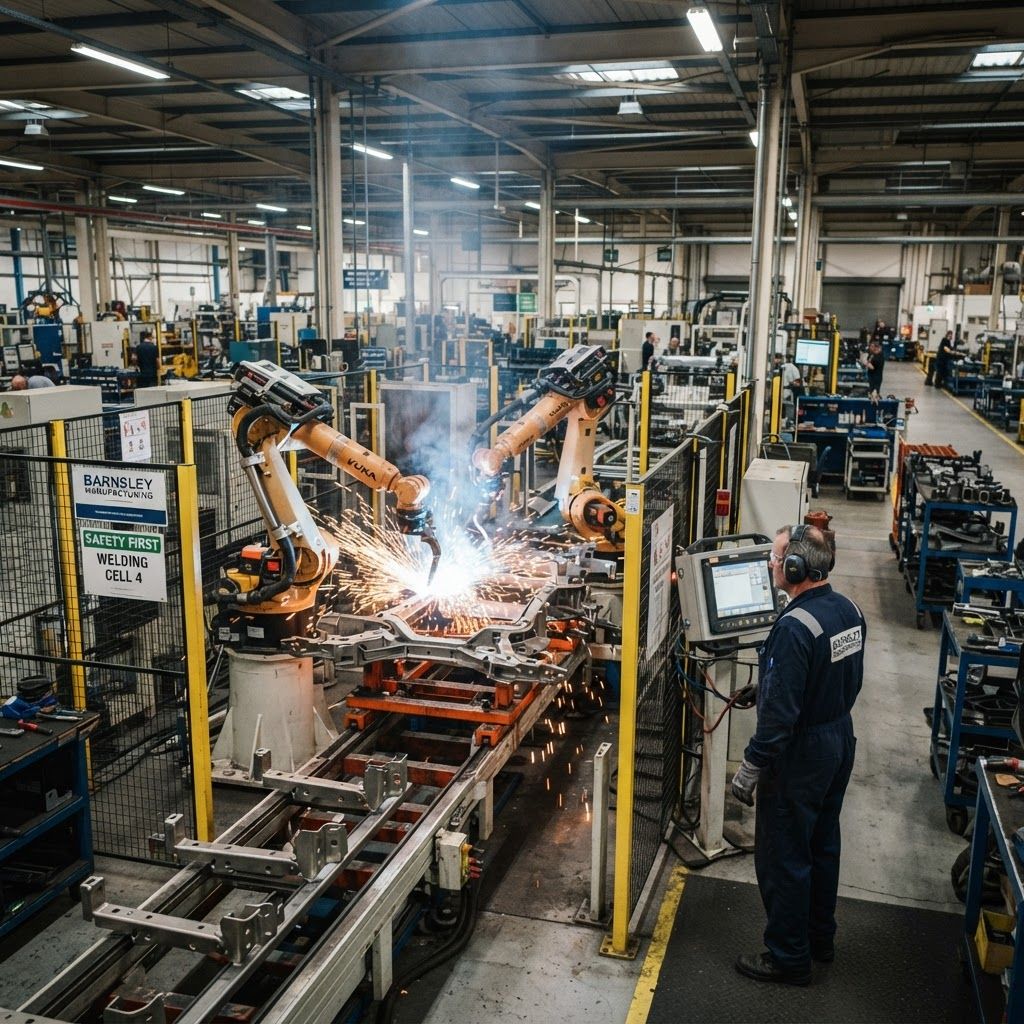
Barnsley's Role in the UK Automotive Supply Chain
Britain's automotive industry is often discussed in terms of its large vehicle assembly plants, but the sector's real depth lies in the tiers of component manufacturers, machining specialists, tooling firms and engineering consultancies that supply them. Barnsley is firmly part of that supply chain landscape. Its position on the M1 corridor places it within straightforward reach of vehicle plants and major tier one suppliers across the Midlands, the North East and the North West, while its proximity to Sheffield's advanced manufacturing research capability gives local firms access to process innovation that would otherwise be out of reach.
The borough's engineering inheritance is directly relevant here. Precision machining, metal forming, fabrication, heat treatment and quality assurance disciplines developed through mining equipment, wire manufacture and general engineering translate readily into automotive component production. Barnsley companies typically operate in specialist niches where technical capability, tight tolerances and reliable delivery performance matter more than the lowest possible piece price.
What the Automotive Sector Demands of Suppliers
Automotive is among the most demanding supply environments in manufacturing. Quality expectations are exacting, with parts per million defect targets rather than percentage tolerances. Certification is effectively mandatory, with IATF 16949 the recognised automotive quality management standard and customers routinely auditing suppliers against their own additional requirements. Delivery performance is critical because assembly lines running just-in-time cannot absorb late deliveries. Traceability must be complete, allowing any component to be traced back through process and material records. Suppliers must also demonstrate capable processes statistically, through PPAP submissions and ongoing capability studies.
Any company operating credibly in this sector has therefore invested substantially in systems, measurement equipment and process discipline. That investment is precisely what distinguishes a genuine automotive supplier from a general engineering firm.
1. Barnsley Precision Components
Barnsley Precision Components produces machined metal components for automotive powertrain, chassis and braking applications, working to the tight tolerances and surface finish requirements those systems demand. Its facility combines CNC turning and milling centres with in-house metrology including coordinate measuring machines and surface finish analysis. The company operates an automotive-aligned quality management system with full material traceability and statistical process control, and it handles both medium volume series production and lower volume specialist runs for niche vehicle manufacturers.
2. Dearne Valley Vehicle Conversions
Dearne Valley Vehicle Conversions specialises in adapting base vehicles for commercial and specialist applications, including panel van racking and shelving systems, refrigerated conversions, welfare and crew vehicles, and accessibility adaptations. Conversion work requires genuine engineering competence covering structural modification, electrical integration, weight distribution and type approval compliance. The company handles the regulatory dimension properly, which is essential since improperly executed conversions can invalidate vehicle approval and insurance.
3. Steelworks Energy Engineering
Steelworks Energy Engineering contributes to the automotive sector through fabrication, tooling and heavy engineering support, producing jigs, fixtures, press tools and welded assemblies for vehicle and component manufacturers. Its capability in structural steel fabrication and precision welding suits chassis components, brackets and production equipment. The company also supports plant maintenance and installation projects for automotive manufacturing facilities, where its industrial engineering background is directly applicable.
4. Penistone Cable and Harness
Penistone Cable and Harness manufactures wiring harnesses and cable assemblies for automotive and commercial vehicle applications, including engine bay looms, body harnesses and specialist assemblies for converted and low-volume vehicles. Its processes include automated cut and strip, verified crimping with pull-force testing, overmoulding and comprehensive electrical testing. As vehicles carry ever more electrical content, harness quality has become a leading determinant of overall vehicle reliability, and the company's testing rigour addresses that directly.
5. Hoyland Automotive Plastics
Hoyland Automotive Plastics produces injection moulded and thermoformed plastic components for vehicle interiors, trim, ducting and under-bonnet applications. Its capability spans tool design coordination, moulding across a range of engineering polymers, and secondary operations including welding, assembly and surface finishing. The company has invested in recycled and bio-based polymer processing, responding to vehicle manufacturers' increasing requirements around material sustainability and end-of-life recyclability.
6. Cudworth Surface Treatments
Cudworth Surface Treatments provides coating, plating and finishing services to automotive component manufacturers, including zinc and zinc-nickel plating, phosphating, powder coating, passivation and specialist corrosion protection. Corrosion performance requirements in automotive applications are stringent, with salt spray testing to demanding hour counts, and the company operates the process control and testing capability needed to certify performance. Its work extends component life and satisfies OEM specifications that general finishers cannot meet.
7. Worsbrough Motorsport Engineering
Worsbrough Motorsport Engineering serves the motorsport and performance vehicle market, producing bespoke components, roll cages, suspension parts and lightweight assemblies. Motorsport work demands rapid iteration, extremely tight tolerances and creative problem solving under time pressure, and the disciplines developed there frequently transfer into mainstream automotive engineering. The company also undertakes prototype and low-volume work for manufacturers developing new platforms, where its speed and flexibility are considerable assets.
8. Barugh Green EV Systems
Barugh Green EV Systems focuses on electric vehicle technology, working on battery module assembly, battery management system integration, thermal management components and high-voltage cable and connector assemblies. Electrification represents the most significant transformation the automotive industry has faced, and it creates entirely new component categories while eliminating others. The company's investment in high-voltage safety training, insulation testing and thermal validation positions it well within that shift, and it supports both vehicle converters and component developers.
9. Northern Vehicle Remanufacturing
Northern Vehicle Remanufacturing operates in the circular economy end of the sector, remanufacturing components including starters, alternators, steering units, turbochargers and gearboxes to original specification. Remanufacturing consumes a fraction of the energy and material of new production while delivering equivalent performance, and it keeps older vehicles serviceable and affordable. The company's disassembly, inspection, machining, reassembly and test processes are properly documented, giving customers genuine confidence in remanufactured units rather than simply cheaper used parts.
10. Silkstone Tooling and Fixtures
Silkstone Tooling and Fixtures designs and manufactures the production tooling that automotive manufacturing depends upon, including press tools, welding fixtures, assembly jigs and gauging equipment. Tooling quality directly determines the quality and consistency of every part produced from it, making this upstream work disproportionately important. The company combines CAD and simulation-led design with precision toolroom machining, and it provides ongoing tool maintenance and refurbishment that extends tooling life considerably.
Electrification and Its Local Impact
The transition to electric vehicles is redrawing the automotive supply chain, and Barnsley companies are navigating that shift with varying degrees of exposure. Firms supplying engine, exhaust and fuel system components face structural decline in their traditional markets and must diversify. Those making structural, chassis, interior and thermal management parts are broadly insulated, since electric vehicles need these in comparable or greater quantities. New opportunities are emerging in battery assembly, power electronics, high-voltage cabling, lightweight structures and thermal management, all areas where the borough's machining, fabrication and assembly capabilities are transferable.
Lightweighting is a related driver, since battery mass makes weight reduction elsewhere in the vehicle more valuable. That favours aluminium, composites and optimised design, creating demand for the precision machining and specialist fabrication that local firms provide.
Choosing an Automotive Supplier
Verify quality certification early and confirm it covers the specific processes you need. Ask for process capability data rather than general quality assurances, and request evidence of delivery performance over a sustained period. Understand the supplier's own supply chain, since a capable machinist dependent on a single fragile material source is a risk. Discuss capacity honestly against your volume forecasts, and clarify how engineering changes will be managed, since automotive programmes invariably involve them. For electrification-related work, confirm that high-voltage safety competence and appropriate testing capability genuinely exist rather than being aspirational.
Final Thoughts
Barnsley's automotive manufacturers occupy specialist positions in a demanding supply chain, competing on precision, responsiveness, quality documentation and engineering collaboration rather than volume pricing. The sector faces real disruption from electrification, but the borough's underlying strengths in machining, fabrication, harness assembly, tooling and surface treatment transfer well into the emerging landscape. For vehicle manufacturers, converters and tier one suppliers seeking capable partners in the north of England, these ten companies represent a substantial and adaptable base of capability.
Want your brand featured in front of decision-makers? Publish a guest post or get a link insertion in our guides through AAMAX's guest post and link insertion service.
Helpful Links
 SponsoredAAMAX — Full-Service Digital Agency
Write for Us
Share your expertise with our readers. We welcome guest contributions from industry specialists.
Pitch your idea

