

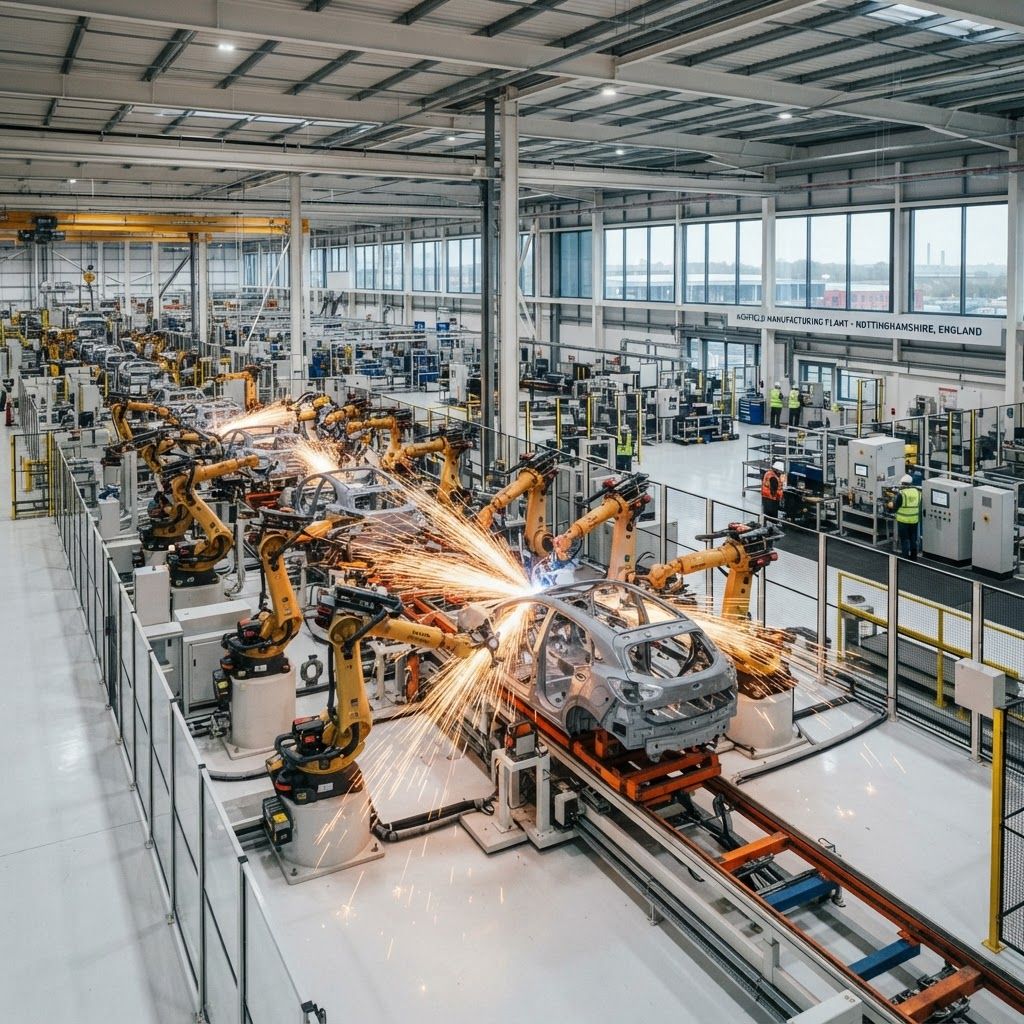
Automotive Manufacturing in Ashfield
The automotive industry in Ashfield operates predominantly within the supply chain rather than final vehicle assembly. The district hosts component manufacturers, pressing and machining specialists, plastics and rubber processors, tooling makers, surface treatment providers and vehicle conversion businesses. Together these firms supply into vehicle manufacturers, tier one suppliers and the aftermarket across the United Kingdom and Europe.
The East Midlands location is strategically useful. Major vehicle plants and engineering centres lie within convenient reach, motorway connectivity supports just-in-time delivery, and the region retains a deep base of mechanical engineering skill. For a component supplier, proximity to customers is a genuine commercial advantage when delivery schedules are measured in hours rather than days.
The Capabilities Present in the District
Metal forming and pressing covers stamped panels, brackets, structural components and deep-drawn parts, supported by press tool design and manufacture. Progression tooling and transfer press capability allow high-volume production of complex geometries.
Precision machining produces engine, transmission, braking and suspension components to tight tolerances, using computer-controlled turning and milling centres with in-process measurement.
Plastics and polymer processing includes injection moulding of interior and under-bonnet components, rubber extrusion and moulding for seals and mountings, and composite parts for lightweight applications.
Fabrication and welding serves structural assemblies, chassis components, exhaust systems and commercial vehicle bodywork, frequently combining robotic welding with skilled manual work for complex geometries.
Surface treatment and finishing covers powder coating, electroplating, anodising, phosphating and painting, all critical for corrosion protection in automotive applications.
Vehicle conversion and specialist engineering is a notable niche, covering commercial vehicle bodies, welfare and accessibility conversions, emergency service vehicles and bespoke fit-outs. This work combines mechanical, electrical and coachbuilding skill.
Tooling, jigs and fixtures manufacturing supports the wider industry, producing the press tools, moulds, welding jigs and inspection fixtures that production depends upon.
What Distinguishes the Leading Automotive Manufacturers
The automotive supply chain applies some of the most demanding standards in manufacturing, and the strongest local firms reflect this. Automotive quality certification is effectively mandatory for direct supply, requiring documented process control, advanced product quality planning, production part approval processes and failure mode analysis.
Measurement and metrology capability distinguishes serious suppliers. Coordinated measuring machines, gauge repeatability studies, statistical process control and full dimensional reporting provide the evidence customers require.
Delivery performance is measured relentlessly in this industry. Suppliers are scored on on-time delivery and defect rates, and consistent performance against these metrics determines whether contracts are renewed.
Cost engineering is a permanent expectation. Automotive contracts frequently include year-on-year price reduction commitments, which can only be met through genuine productivity improvement, material optimisation and waste elimination rather than margin erosion.
Programme management capability matters for new model work, where suppliers must coordinate design validation, tooling manufacture, sample approval and capacity ramp-up against fixed launch dates.
How Electrification Is Changing the Sector
The transition to electric vehicles represents the most significant change the industry has faced in a century, and its effects are being felt directly in Ashfield.
Component demand is shifting. Internal combustion engines contain thousands of parts that electric powertrains simply do not require. Suppliers historically dependent on engine, fuel system and exhaust components face structural decline unless they diversify.
New opportunities are emerging in battery enclosures and housings, thermal management systems, high-voltage cable assemblies and connectors, electric motor components, power electronics cooling and lightweight structural parts.
Lightweighting has intensified as manufacturers offset battery mass, increasing demand for aluminium forming, high-strength steel processing and composite components.
Thermal management has become far more complex, as battery packs require precise temperature control for performance, longevity and safety, creating demand for cooling plates, heat exchangers and associated assemblies.
Skills transition is underway, with high-voltage working competence, battery safety training and power electronics knowledge becoming necessary alongside traditional mechanical skills.
Supply chain localisation is being encouraged by rules of origin requirements, creating genuine opportunity for domestic suppliers able to meet automotive standards.
Selecting an Automotive Manufacturing Partner
Verify quality certification appropriate to your position in the supply chain, and review recent customer scorecard performance if available.
Assess capacity honestly against your volume requirements, including whether the supplier can support ramp-up and volume fluctuation.
Examine measurement capability and ask to see sample inspection reports from comparable parts.
Discuss tooling ownership, maintenance responsibility and what happens to tooling at end of programme.
Evaluate engineering involvement. Suppliers contributing design for manufacture input early reduce cost and risk substantially compared with those quoting purely to drawing.
Consider financial stability and diversification, particularly given the structural change electrification is causing across the sector.
Why Local Supply Still Matters
There is a persistent assumption that automotive components are inevitably cheaper when sourced from low-cost economies. In practice, the total cost calculation is considerably more nuanced. Extended shipping times require larger inventory buffers, tying up working capital and warehouse space. Quality problems discovered after a container has arrived cannot be resolved quickly. Engineering changes take weeks to implement rather than days. Currency movements and freight rates introduce cost volatility that is difficult to hedge.
Local suppliers in Ashfield counter these disadvantages with responsiveness. A customer can visit the factory, review a problem part on the shop floor and agree a corrective action within a single morning. Prototype iterations move in days. Schedule changes can be accommodated without renegotiating shipping bookings. For components where design is still evolving or where volumes fluctuate, this agility frequently outweighs a lower unit price.
Sustainability reporting has reinforced the argument. Vehicle manufacturers increasingly account for supply chain emissions, and transport distance is a visible contributor. Suppliers within a short road journey of the assembly plant present a measurably lower logistics footprint, which now carries genuine commercial weight in sourcing decisions rather than being treated as a secondary consideration.
The Outlook
Automotive manufacturing in Ashfield faces genuine transition but also real opportunity. Firms investing in electrification-relevant capability, maintaining rigorous quality systems and diversifying beyond powertrain-dependent components are well positioned. The district's engineering skill base remains a substantial asset as the industry reorganises around new technologies.
Want your brand featured in front of decision-makers? Publish a guest post or get a link insertion in our guides through AAMAX's guest post and link insertion service.
Helpful Links
 SponsoredAAMAX — Full-Service Digital Agency
Write for Us
Share your expertise with our readers. We welcome guest contributions from industry specialists.
Pitch your idea

