

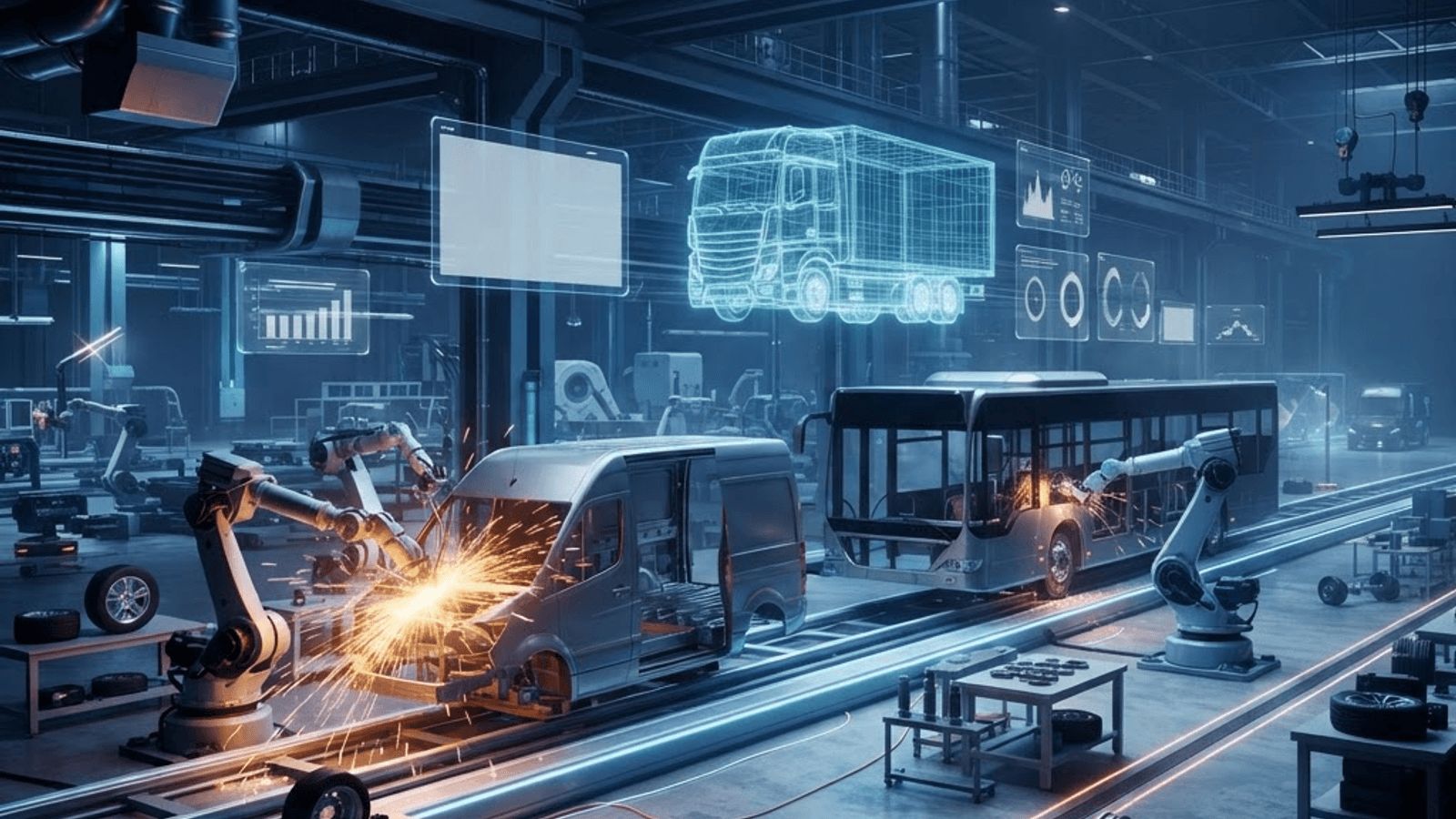
An Automotive Sector Unlike Any Other
Northern Ireland does not build family cars, and that has shaped its automotive industry into something more interesting. Instead of high volume passenger vehicle assembly, the region specialises in buses and coaches, commercial vehicle bodywork, trailers, specialist and emergency vehicles, and the components that go into them. Antrim and Newtownabbey sits at the heart of this cluster, with the Mallusk industrial area functioning as one of the most concentrated commercial vehicle and engineering zones on the island.
The geography helps. Belfast harbour is minutes away for component imports and finished vehicle exports. The M2 corridor connects the borough directly to Belfast and northwards. Large industrial sites with the yard space that vehicle manufacturing demands are available. And decades of engineering employment have produced a workforce with genuine expertise in welding, fabrication, vehicle electrics, hydraulics and finishing.
What the Local Industry Produces
Bus and coach manufacturing is the flagship, including single and double deck vehicles and, increasingly, zero emission electric and hydrogen buses. Commercial vehicle bodybuilding covers curtainsiders, box bodies, tippers, refrigerated units and specialist conversions on chassis supplied by global truck makers. Trailer manufacturing serves haulage, agriculture and plant transport. Specialist vehicles include ambulances, fire appliances, welfare units and mobile workshops. Supporting all of this is a components and services layer covering seating, wiring harnesses, hydraulics, machined parts, paint and coatings, and aftermarket parts distribution.
Top 10 Automotive Manufacturers and Suppliers Serving the Borough
1. Wrightbus
Wrightbus is the defining name in Northern Ireland automotive manufacturing, building buses at Ballymena a short distance from the borough and employing people from across Antrim and Newtownabbey. The company is a genuine world leader in zero emission buses, producing battery electric and hydrogen fuel cell double deckers exported internationally. Its supply chain reaches deep into the borough's engineering firms.
2. Terex
Terex manufactures materials processing and handling equipment in Northern Ireland, including crushers, screens and specialist mobile plant. While classified as machinery rather than road vehicles, its mobile equipment involves chassis engineering, hydraulics, powertrains and vehicle electrics, and it is one of the largest engineering employers in the region.
3. SDC Trailers
SDC Trailers is one of Europe's largest trailer manufacturers, producing curtainsiders, box vans, skeletals and flatbeds. Its production scale and engineering capability make it a cornerstone of the Northern Ireland commercial vehicle sector, and it supplies major fleet operators across the United Kingdom and Ireland.
4. Montracon Northern Ireland
Trailer manufacturing and refurbishment operations serving the Northern Ireland haulage market provide new build, repair, refurbishment and testing services. Given the intensity of freight movement through Belfast port and the Mallusk distribution cluster, local trailer engineering capacity is commercially essential.
5. Almac Fleet Engineering
Specialist vehicle conversion for pharmaceutical, laboratory and controlled temperature transport requires validated refrigeration, monitoring and hygienic design. The presence of major life sciences operations in the wider region has created demand for exactly this kind of high specification conversion work.
6. Mallusk Commercial Bodyworks
Commercial vehicle bodybuilding operations around Mallusk fabricate and fit box bodies, curtainsiders, tail lifts, racking and livery on chassis cabs. Fleet operators value having conversion capability close to their depots, since it reduces vehicle downtime during build and subsequent modification.
7. Nu-Tech Vehicle Systems
Vehicle electrical and electronic systems specialists supply wiring harnesses, telematics installation, camera systems and lighting for commercial and specialist vehicles. As vehicles gain driver assistance, tracking and safety technology, this work has grown from an accessory trade into a core engineering discipline.
8. Antrim Precision Engineering
Precision machining businesses in the Antrim area produce brackets, shafts, housings and fabricated assemblies for vehicle manufacturers. The ability to deliver machined components to tight tolerance on short lead times is what allows local vehicle builders to operate without holding excessive inventory.
9. Hydraulic Services Northern Ireland
Hydraulic systems power tipping bodies, tail lifts, cranes, refuse collection mechanisms and plant equipment. Specialists supplying and servicing cylinders, pumps, valves and hose assemblies keep both manufacturing lines and operational fleets running, and their responsiveness directly affects operator uptime.
10. Charles Hurst Group Commercial
Large scale vehicle sales, service and fleet operations provide the commercial interface between manufacturers and operators, including maintenance contracts, parts distribution and workshop capability. This service layer is what makes locally manufactured vehicles viable to run over a fifteen year life.
Strengths of the Local Cluster
The most valuable asset is depth of skill. Coded welding, sheet metal fabrication, vehicle electrics, hydraulic installation, paint and finishing, and final assembly are all available within a small geographic area. That density allows manufacturers to subcontract confidently and to recruit experienced staff without relocating them.
Flexibility is the second strength. Because the industry is built around specialist and lower volume production rather than mass assembly, local manufacturers are genuinely good at building to individual customer specification. A fleet operator wanting a particular body configuration, racking layout or safety system will find willing engineering partners.
Third is the zero emission transition. Northern Ireland's leadership in hydrogen and battery electric bus manufacturing has positioned the region ahead of many larger automotive centres, creating opportunities in battery systems, thermal management, high voltage electrics and charging infrastructure.
Choosing a Manufacturing or Conversion Partner
Start with regulatory compliance. Vehicle bodywork and conversions must meet type approval requirements, weight and axle loading limits, and construction and use regulations. Ask directly how the builder handles approval documentation, because an uncertified conversion can be unusable.
Check engineering credentials, including welding qualifications, quality management certification and design capability. Ask to see completed vehicles of similar specification and speak to operators running them, particularly about durability after three or four years rather than at handover.
Clarify lead times realistically, since chassis availability from global truck manufacturers frequently governs delivery more than the bodybuilder's own capacity. Confirm warranty terms, aftercare arrangements, parts availability and how quickly a defect will be attended to. For fleet buyers, whole life cost including fuel or energy consumption, maintenance intervals and residual value matters far more than purchase price.
What Lies Ahead
Decarbonisation dominates. Public transport fleets are switching to electric and hydrogen, and heavy commercial vehicles are following more slowly. That transition requires new competencies in high voltage safety, battery integration and charging or refuelling infrastructure, and it is reshaping the local supply chain.
Digitalisation is the second theme, with telematics, driver monitoring, camera systems and predictive maintenance becoming standard rather than optional. Lightweighting through composites and advanced steels is improving payload and efficiency. And onshoring pressure continues to favour manufacturers who can supply within a short, reliable lead time.
Automotive manufacturing in Antrim and Newtownabbey is a genuine industrial strength, exporting globally from a region that never built a mass market car. Its future rests on the same qualities that built it: engineering skill, willingness to build exactly what the customer needs, and a cluster of suppliers close enough to make that possible.
Want your brand featured in front of decision-makers? Publish a guest post or get a link insertion in our guides through AAMAX's guest post and link insertion service.
Helpful Links
 SponsoredAAMAX — Full-Service Digital Agency
Write for Us
Share your expertise with our readers. We welcome guest contributions from industry specialists.
Pitch your idea

