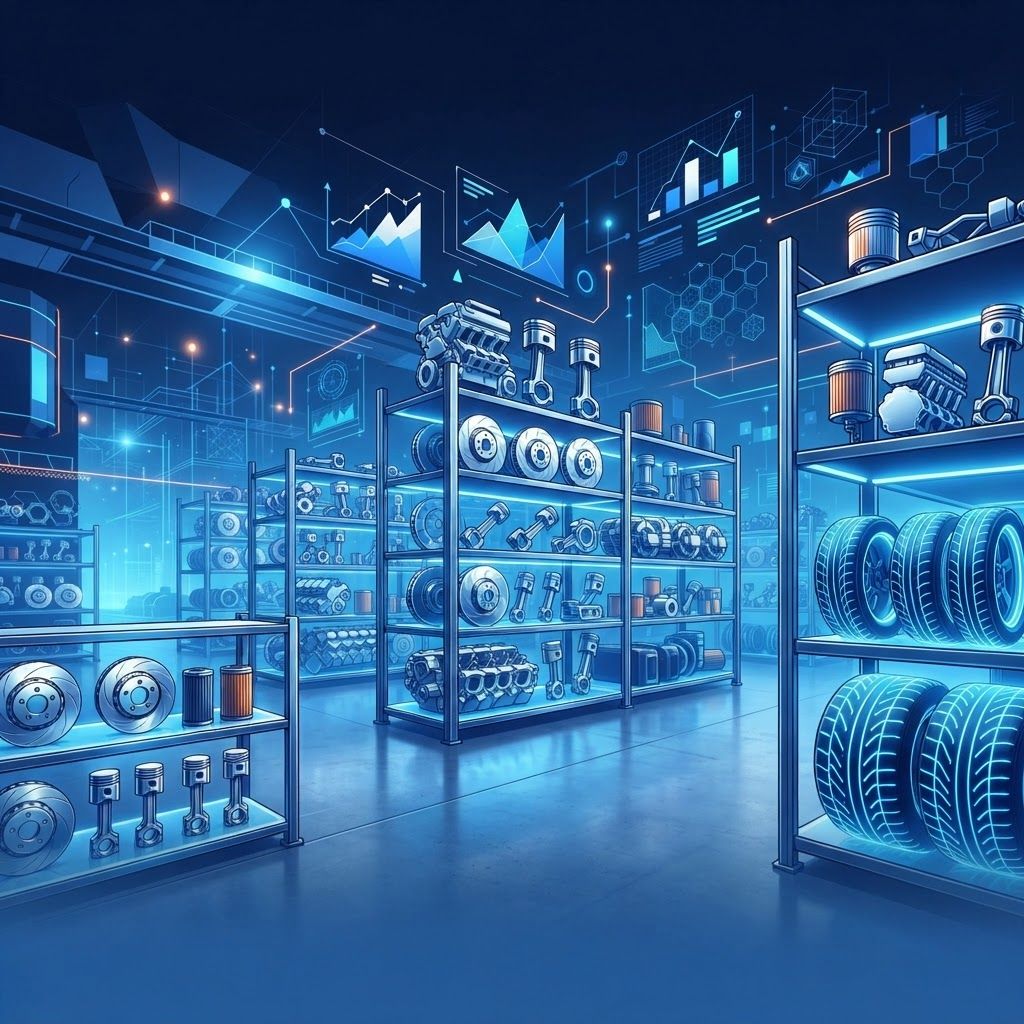
Why Parts Distribution Matters Across Broadland
Broadland is a district where vehicles are essential. Public transport is limited across the villages, commuting into Norwich is common, agricultural machinery and commercial vehicles support the rural economy, and the Broads tourism sector generates significant seasonal traffic. That dependence sustains a large network of independent garages, tyre specialists, mobile mechanics, fleet workshops and agricultural engineers, all of whom depend on fast, accurate parts supply.
The economics of vehicle repair make delivery speed extraordinarily important. A car on a ramp waiting for a part occupies a bay that generates no revenue, and a customer without a vehicle quickly becomes dissatisfied. This is why the best parts wholesalers in the area run multiple daily delivery runs rather than a single overnight service, and why trade counters remain heavily used despite the growth of online ordering.
The Main Categories of Auto Parts Wholesaler
General motor factors form the core of the market, stocking service items, brakes, filters, clutches, suspension, steering, electrical components and consumables for a wide range of makes. Their strength is catalogue breadth combined with local stock, allowing a garage to complete most jobs without waiting.
Commercial vehicle and truck parts specialists form a second category, serving haulage operators, agricultural contractors and plant fleets. Heavier components, air braking systems, specialist filtration and different regulatory requirements distinguish this segment from car parts supply.
Agricultural and plant parts distributors are particularly relevant in a district like Broadland. Tractors, combines, sprayers, telehandlers and trailers all require parts, and harvest-season downtime is intolerable, so suppliers offering out-of-hours access are highly valued.
Tyre wholesalers form a fourth category, supplying car, van, commercial, agricultural and specialist tyres to fitting centres. Stock breadth across sizes and brands, plus rapid replenishment, defines performance here.
Other categories include auto electrical specialists covering batteries, alternators, starters and increasingly complex vehicle electronics; body panel and collision repair suppliers serving accident repair centres; paint and refinishing distributors providing mixing systems and consumables; lubricants and chemicals wholesalers; garage equipment suppliers providing lifts, diagnostic tools and tyre machines; and performance or classic car parts specialists serving Norfolk's active enthusiast community.
Understanding Parts Quality Tiers
One of the most valuable things a good wholesaler does is help a workshop navigate quality tiers honestly. Original equipment parts are supplied in manufacturer packaging at premium prices. Original equipment equivalent parts come from the same factories that supply vehicle manufacturers but in the component maker's own packaging, usually at meaningfully lower cost with equivalent quality.
Aftermarket branded parts from established component manufacturers offer good quality and value, sometimes with design improvements over the original. Budget aftermarket parts vary enormously in quality and should be selected with caution, particularly for safety-critical systems such as braking and steering.
Remanufactured parts represent an increasingly important option. Properly remanufactured alternators, starters, turbochargers, steering racks and even engines are rebuilt to original specification with new wear components and carry full warranties. They cost less than new and carry a substantially lower environmental footprint, which makes them attractive on both counts.
A trustworthy wholesaler explains these distinctions clearly rather than simply quoting the cheapest option, because a failed budget component destroys the garage's reputation, not the supplier's.
Cataloguing, Identification and Technology
Parts identification has become a genuine technical discipline. Modern vehicles have numerous variants, mid-year production changes and options that affect component fitment. Registration and VIN-based lookup systems have transformed accuracy, allowing a garage to order against the specific vehicle rather than a general model description.
The best wholesalers integrate their catalogues directly with garage management software, so a technician can check live stock, see pricing and place an order without leaving the job card. This integration reduces ordering errors, which are the single largest source of friction and wasted delivery journeys in parts distribution.
Technical data services have become equally important. Access to torque settings, service schedules, wiring diagrams and repair times supports the workshop's productivity, and several distributors bundle this data with trade accounts.
The Electric Vehicle Transition
The shift towards electrified vehicles is changing parts demand in ways that Broadland workshops are actively navigating. Electric vehicles eliminate demand for oil filters, spark plugs, exhausts and clutches, while increasing demand for cabin filters, brake fluid, tyres, suspension components and specialist coolant.
High-voltage safety equipment, insulated tooling and diagnostic systems capable of interrogating battery management systems represent new wholesale product lines. Forward-thinking distributors are supporting garages through this transition with training and equipment packages as much as with parts.
Hybrid vehicles create a transitional demand pattern, requiring both conventional service parts and high-voltage capability. Given typical vehicle lifespans, conventional parts demand across Norfolk will remain substantial for many years, but the direction of travel is clear and suppliers who prepare workshops for it are adding real value.
How to Choose an Auto Parts Supplier
Delivery frequency should be the first question. Ask how many runs serve your postcode each day and what the cut-off times are. For a busy workshop, three deliveries a day from a nearby supplier beats a cheaper distributor delivering once overnight.
Test order accuracy over a trial period. Wrong parts cost far more than their price, consuming technician time, delaying jobs and occupying bays. Track the error rate honestly during evaluation.
Clarify returns policies before you need them. Electrical components are frequently non-returnable once fitted, restocking fees vary widely, and surcharge handling on remanufactured units needs to be understood in advance.
Assess warranty support realistically. When a part fails prematurely, the garage bears the labour cost of refitting unless the supplier offers labour claim support. Suppliers backing their products with labour cover provide significant protection.
Finally, consider account structure. Consolidated monthly invoicing, clear trade pricing and a named account contact reduce administration. For most Broadland workshops, the practical answer is to hold accounts with two or three complementary suppliers, giving both price comparison and resilience when one is out of stock.
Want your brand featured in front of decision-makers? Publish a guest post or get a link insertion in our guides through AAMAX's guest post and link insertion service.
Helpful Links
 SponsoredAAMAX — Full-Service Digital Agency
Write for Us
Share your expertise with our readers. We welcome guest contributions from industry specialists.
Pitch your idea