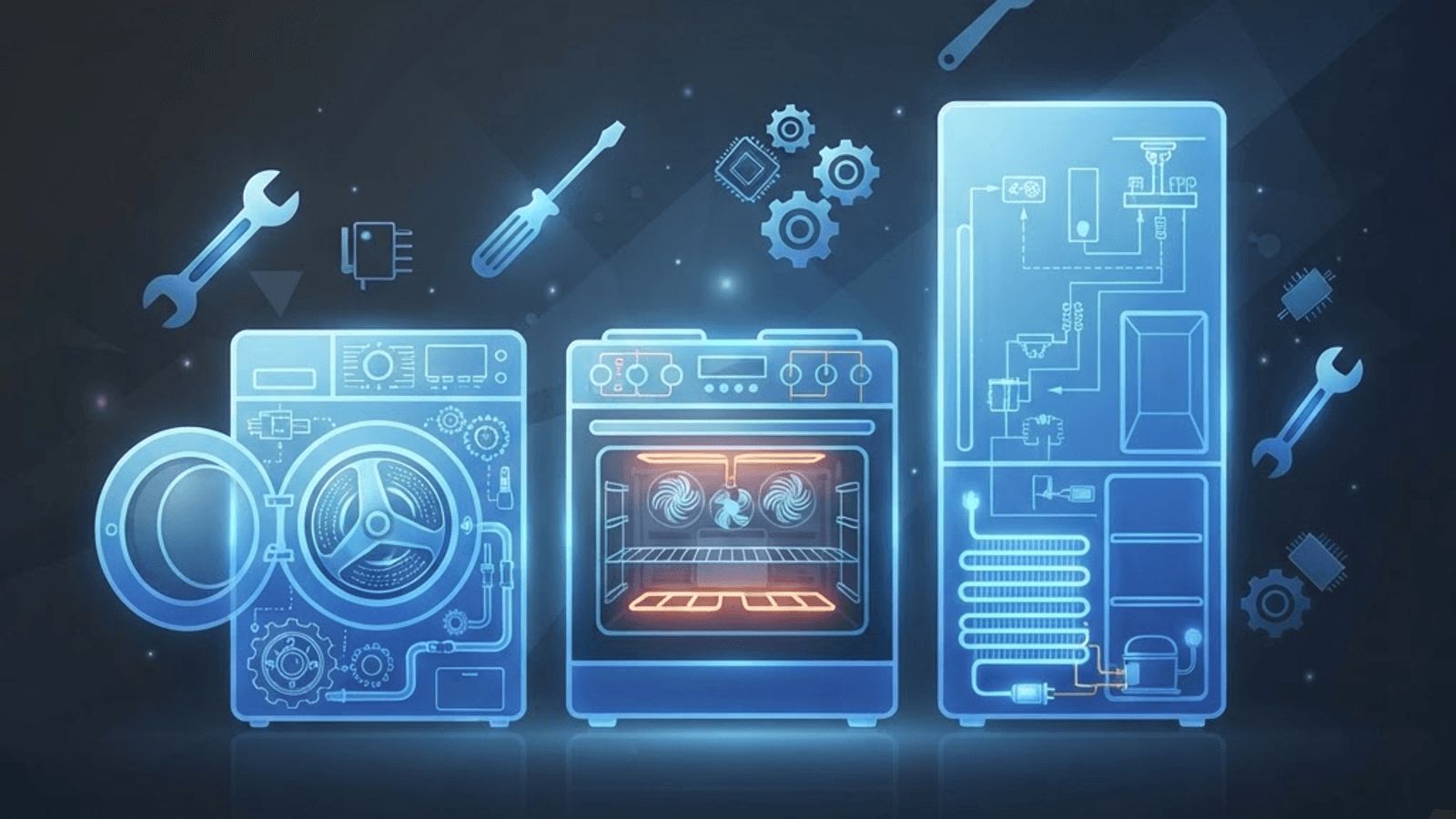
The Case for Repairing Appliances
A failed washing machine, oven or fridge freezer creates immediate disruption in any household, and the default response for many years was replacement. That calculation has shifted. Appliance prices have risen, the environmental cost of manufacturing and disposing of large white goods is increasingly recognised, and right to repair regulations now require manufacturers to make key spare parts available for a defined period after a model leaves the market.
Across North West Leicestershire, a healthy network of independent repair engineers serves households from Coalville and Whitwick through Ashby-de-la-Zouch, Ibstock and Measham out to the rural villages. Many of these businesses are long-established, know the common failure modes of popular models intimately and can often diagnose a fault over the phone before attending.
Common Appliance Faults and What They Mean
Washing machines most frequently fail on bearings, drain pumps, door seals and control boards. A machine that will not spin but drains normally usually points to a motor brush, belt or control fault rather than a pump. Loud rumbling during spin almost always indicates bearing wear. A machine that will not drain is typically blocked by a coin, hairgrip or fabric lodged in the pump filter, which is frequently a five-minute fix.
Tumble dryers commonly suffer from blocked condenser units, failed thermostats and worn drum belts. Poor drying performance is far more often a airflow or filter problem than a heating element failure.
Dishwashers fail on drain pumps, spray arm blockages, door seals and water inlet valves. Persistent poor cleaning is usually limescale and food debris rather than a mechanical fault, particularly in harder water areas of the district.
Ovens typically lose their fan element, thermostat or door seal. An oven that runs consistently hot or cold but otherwise works normally is almost always a thermostat or sensor issue rather than a reason for replacement.
Fridge freezers fail on thermostats, defrost heaters, door seals and, less commonly, compressors. A compressor failure on an older unit is generally the point at which replacement becomes more sensible than repair.
Ten Appliance Repair Services Serving the District
1. Coalville Appliance Repairs
A general domestic repair service covering washing machines, dryers, dishwashers, ovens and fridges, with a good stock of common spares carried on the van.
2. Ashby Domestic Appliance Engineers
A multi-brand repairer handling both freestanding and integrated appliances, with particular experience of built-in units where access is the main difficulty.
3. Donington Commercial Catering Repairs
Focused on commercial kitchens, covering ovens, dishwashers, fryers, refrigeration and extraction for pubs, restaurants and staff canteens across the district.
4. Ivanhoe Washing Machine Specialists
Concentrated on laundry appliances, including bearing replacement, pump and seal work and control board diagnosis across a wide range of brands.
5. National Forest Appliance Care
A repair-first business with a strong sustainability ethos, emphasising component-level repair over module swapping and offering reconditioned appliances.
6. Measham Oven and Hob Services
Specialists in cooking appliances including electric and gas ovens, ceramic and induction hobs, and range cookers, with Gas Safe capability for gas appliances.
7. Whitwick Refrigeration Repairs
Covering domestic and light commercial refrigeration, including sealed system work, thermostat replacement and defrost system faults.
8. Kegworth Integrated Appliance Services
Handling built-in and integrated appliances within fitted kitchens, where removal and refitting requires care to avoid damaging cabinetry and worktops.
9. Charnwood Small Appliance Repair
Focused on smaller items including microwaves, vacuum cleaners, coffee machines and food preparation equipment, often overlooked by larger repairers.
10. Moira Rural Appliance Engineers
Serving outlying villages and farms where call-out coverage can be patchy, including appliances in outbuildings and utility spaces.
Repair or Replace: Making the Decision
A widely used rule of thumb suggests repairing when the cost is less than half the price of an equivalent replacement and the appliance is not near the end of its expected life. Typical service life is around ten years for a washing machine or dishwasher, twelve to fifteen for an oven and ten to fifteen for a fridge freezer.
Energy efficiency should enter the calculation for older appliances. A twelve-year-old fridge freezer running continuously may cost substantially more per year to operate than a current model, which can offset a replacement over several years. For washing machines and ovens, which run intermittently, the efficiency argument is weaker and repair usually wins.
Availability of parts matters. Under current regulations manufacturers must supply specified spare parts for a defined period, but for appliances beyond that window a competent engineer may still source compatible or reconditioned components.
Getting the Best From a Repair Service
Have the model and serial number ready when you call. This allows the engineer to check parts availability and often to bring the likely component on the first visit, avoiding a second call-out charge.
Ask how the call-out fee works. Most repairers charge a diagnostic fee that is either absorbed into the repair cost or charged separately if you decline the work. Clarify whether parts and labour are both included in a quoted price and what guarantee applies to the repair.
Check for Gas Safe registration for any gas appliance and for relevant refrigeration qualifications where sealed system work is involved.
Before booking, carry out the basic checks. Confirm the appliance has power, that the fuse in the plug is intact, that filters are clean and that drain hoses are not kinked or blocked. A meaningful proportion of call-outs resolve at this level.
Extending Appliance Life
Clean filters regularly on washing machines, dishwashers and dryers. Run a maintenance wash at high temperature periodically to clear detergent residue and biofilm. Avoid overloading, which accelerates bearing and suspension wear. Descale in hard water areas. Keep fridge and freezer door seals clean and check they still grip a sheet of paper when closed. Ensure appliances have adequate ventilation, particularly integrated fridges and freezers.
Final Thoughts
Appliance repair in North West Leicestershire is well served by experienced independent engineers who can usually restore a failed machine for a fraction of replacement cost. With right to repair rules improving parts availability and household budgets under pressure, the repair-first approach makes both financial and environmental sense for most appliances that have not yet reached the end of their design life.
Want your brand featured in front of decision-makers? Publish a guest post or get a link insertion in our guides through AAMAX's guest post and link insertion service.
Helpful Links
 SponsoredAAMAX — Full-Service Digital Agency
Write for Us
Share your expertise with our readers. We welcome guest contributions from industry specialists.
Pitch your idea