

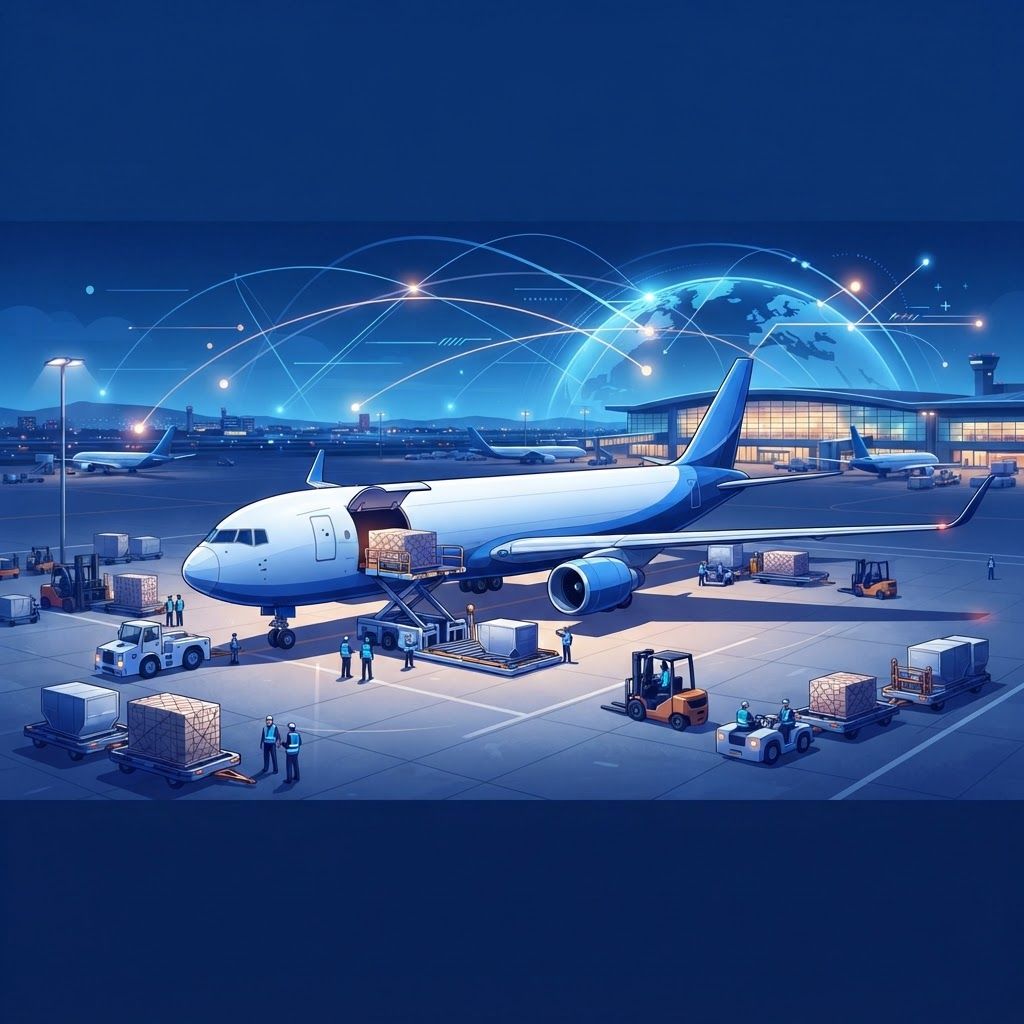
Air Cargo and the Suffolk Economy
Air freight accounts for a small share of global trade by weight but a substantial share by value, because the goods that justify the cost are those where speed or fragility matters most: pharmaceuticals, electronics, aerospace components, perishable food, high-value machinery parts and urgent samples. Businesses around Ipswich in technology, life sciences, agriculture and precision engineering all use it regularly.
Ipswich has no airport of its own, but access is straightforward. London Stansted is the closest major freight airport and one of the country's most significant cargo hubs. Heathrow handles the largest volume nationally, much of it in the holds of passenger aircraft. East Midlands is the leading express freight hub, and Norwich offers regional capability. The following ten cover the providers Suffolk shippers use.
1. DHL Global Forwarding and Express
DHL operates both an express network for documents and parcels and a forwarding business handling larger air freight consignments. The combination means it can serve everything from an urgent envelope to a multi-tonne shipment. Its network density and customs capability make it a default choice for many businesses sending time-critical goods internationally.
2. FedEx
FedEx provides express air services with guaranteed delivery windows to destinations worldwide, supported by its own aircraft fleet and integrated tracking. For Ipswich businesses shipping samples, spare parts or documents where a specific delivery time is contractually required, the reliability of a dedicated integrator network is the primary attraction.
3. UPS
UPS combines express air services with freight forwarding and supply chain solutions. Its strength in transatlantic trade is particularly relevant to Suffolk technology and engineering businesses working with North American customers and suppliers. Its brokerage capability simplifies customs clearance, which is often the slowest part of an otherwise fast shipment.
4. TNT and Integrated Networks
Now part of a larger group, TNT's European road and air network remains widely used for time-sensitive movements within Europe. For shipments where a next-day or two-day European delivery is needed but full air freight cost is unjustified, these hybrid road-air services often provide the best balance of speed and price.
5. Air Freight Forwarders Serving Stansted
Specialist forwarders located near Stansted handle consolidation, airline booking, airside handling, documentation and customs clearance. Working with a forwarder rather than booking directly gives access to negotiated airline rates and, critically, to someone who understands dangerous goods regulations, temperature requirements and airline-specific acceptance procedures.
6. Cargolux and Dedicated Freighter Operators
Dedicated cargo airlines operate pure freighter aircraft on scheduled and charter services, handling consignments too large or unusual for passenger aircraft holds. Outsized machinery, livestock, vehicles and project cargo move this way. For Suffolk manufacturers exporting large equipment urgently, freighter capacity is sometimes the only viable option.
7. Emirates SkyCargo and Passenger Airline Cargo Divisions
Major passenger airlines carry substantial freight in the holds of scheduled flights, offering extensive destination coverage through their hub networks. Carriers serving the Middle East, Asia and Africa provide routings that dedicated freighter networks do not always match, and their frequency means shipments rarely wait long for capacity.
8. Perishable and Temperature-Controlled Air Freight Specialists
Suffolk's agricultural and food sector generates demand for temperature-controlled air freight, and pharmaceutical shipments require validated cold chain handling with continuous monitoring. Specialists in this field provide insulated packaging, temperature loggers, priority handling and documented chain-of-custody records. The compliance requirements, particularly for pharmaceuticals, are demanding and not something a generalist should attempt.
9. Charter Brokers and On-Board Courier Services
When a production line is stopped or a critical component is missing, cost becomes secondary to speed. Charter brokers arrange dedicated aircraft at short notice, while on-board courier services put a person on the next available passenger flight carrying the item as accompanied baggage. Both are expensive, but measured against the cost of a halted factory they are frequently the rational choice.
10. Customs Brokers for Air Consignments
Air freight moves fast, which means customs clearance must be equally quick or the speed advantage is lost on the ground. Brokers specialising in air consignments prepare declarations in advance of arrival, manage duty and tax payment, handle controlled goods licensing and resolve queries rapidly. Their performance often determines whether an express shipment actually arrives on time.
Choosing Between Air and Alternatives
Air freight typically costs several times more than sea freight per kilogram but reduces transit from weeks to days. The decision should account for total cost rather than freight alone: faster transit reduces inventory holding, frees working capital and can avoid lost sales. For low-value, high-weight goods the calculation almost always favours sea. For high-value, low-weight or urgent goods, air usually wins even at a much higher rate.
Packing, Documentation and Restrictions
Air cargo is charged on the greater of actual weight or volumetric weight, so efficient packing directly reduces cost. Consignments must comply with dangerous goods regulations, which cover far more than obvious hazards: lithium batteries, aerosols, magnets and certain chemicals all require declaration and correct packaging. Air waybills, commercial invoices and any required licences must be accurate, because errors discovered airside cause significant delay.
Sustainability Considerations
Air freight carries the highest carbon intensity of any transport mode, and businesses reporting supply chain emissions face growing pressure to reduce reliance on it. Practical responses include better demand forecasting to avoid emergency shipments, consolidating consignments, using sea-air combinations for medium-urgency freight, and purchasing sustainable aviation fuel contributions where carriers offer them.
Practical Advice for Ipswich Shippers
Build a relationship with a forwarder before you need one urgently, because the worst time to select a supplier is during a crisis. Keep product classification codes, dimensions and weights documented so quotes can be produced quickly. Understand your incoterms so responsibility for cost and risk is unambiguous. With Stansted barely over an hour away and a competitive forwarding market in the region, Suffolk businesses are unusually well placed to use air freight effectively when it is genuinely the right answer.
Want your brand featured in front of decision-makers? Publish a guest post or get a link insertion in our guides through AAMAX's guest post and link insertion service.
Helpful Links
 SponsoredAAMAX — Full-Service Digital Agency
Write for Us
Share your expertise with our readers. We welcome guest contributions from industry specialists.
Pitch your idea

