

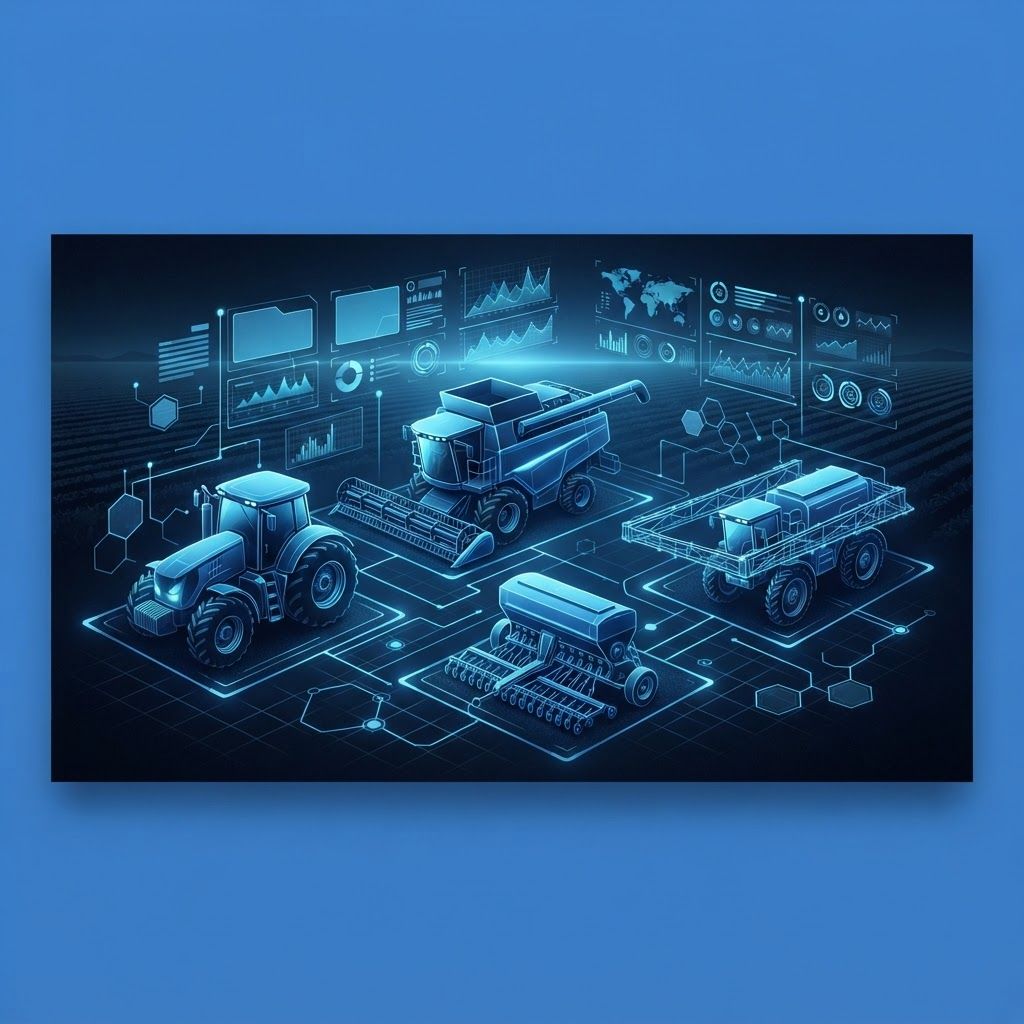
Machinery and the Hampshire Farming Landscape
The arable and mixed farms surrounding Winchester operate on chalk soils that reward careful cultivation and punish compaction. Fields are often large enough to justify substantial machinery, yet the landscape includes steep downland slopes, narrow lanes and villages that impose practical limits on size. Machinery choice therefore balances capacity against manoeuvrability, and horsepower against soil protection.
Brand loyalty in agriculture runs deeper than in almost any other equipment sector, and for good reason. A tractor is a fifteen-year investment, and its value depends as much on the dealer who supports it as on the badge on the bonnet. Farms around Winchester typically choose a brand and stay with it, building a relationship with the local dealership that delivers rapid parts supply and field service during the narrow windows when work must happen.
1. John Deere
John Deere remains the most widely recognised agricultural machinery brand globally and is strongly represented across Hampshire arable farms. Its tractors are valued for cab comfort, transmission refinement and, crucially, the maturity of its precision farming ecosystem. Guidance, section control, variable rate application and data management are integrated rather than bolted on, which appeals to growers running detailed agronomic programmes. Combine harvesters from the brand are common on larger downland holdings, where harvest capacity determines whether crops are gathered in good condition.
2. New Holland
New Holland has a long-standing presence in British farming and offers a broad range from compact tractors suited to estate and grassland work up to high-horsepower arable machines. The brand is particularly well regarded for its combine harvesters and balers. Around Winchester, where mixed farms handle both cereals and forage, that breadth means one dealer relationship can cover the entire machinery fleet. New Holland has also pursued alternative fuels, including methane-powered tractors, which interests farms with anaerobic digestion capability.
3. Massey Ferguson
Massey Ferguson combines a heritage reputation with modern engineering and is often chosen by farms prioritising straightforward, serviceable machinery. Its mid-range tractors are workhorses on Hampshire livestock and mixed farms, handling loader work, forage operations and general haulage. The brand's appeal lies in practical usability and comparatively accessible pricing, alongside a well-established dealer and parts network.
4. Case IH
Case IH builds high-horsepower tractors and harvesting equipment with a strong following among larger arable operators. Its continuously variable transmissions and tracked machines address the compaction concerns that matter greatly on chalk and clay-with-flints soils. Rotary combine technology handles high-throughput harvesting well, which is significant when the Hampshire harvest window can close abruptly with a change in weather.
5. Fendt
Fendt occupies the premium end of the tractor market and is increasingly visible on Hampshire farms and contracting operations. The proposition is efficiency: sophisticated transmissions, precise engine and implement integration, and build quality that supports very high annual hours. The purchase price is substantial, but operators point to fuel efficiency, residual values and reliability during critical periods as justification. Contractors covering large areas for multiple clients are particularly represented among buyers.
6. Claas
Claas is best known for harvesting machinery, and its combines and forage harvesters are widely used across the south. The brand's strength is throughput and grain sample quality, both of which translate directly into money at the point of sale. Its tractors and balers have also gained ground. For farms where the contractor rather than the owner harvests, the machine arriving in the field is frequently from this manufacturer.
7. JCB
JCB is a British manufacturer with a distinctive position in agriculture through its telescopic handlers. The telehandler has become indispensable on modern farms, loading grain, handling bales, stacking pallets, feeding livestock and supporting construction tasks. The brand's Fastrac tractors also occupy a unique niche, combining high road speed with field capability, which suits farms and contractors travelling between scattered blocks of land around Winchester.
8. Kuhn
Implement manufacturers matter as much as tractor brands, and Kuhn supplies cultivation equipment, mowers, tedders, rakes, balers, spreaders and sprayers. Its strength is engineering detail in the components that determine work quality: the precision of a fertiliser spreader's distribution pattern, the cleanliness of a mower's cut, the density of a bale. On chalk soils where establishment quality drives yield, implement performance is often more consequential than tractor horsepower.
9. Vaderstad
Vaderstad specialises in seed drills and cultivation equipment and has a strong reputation among arable growers seeking consistent establishment. Its drills handle both conventional and reduced-cultivation systems, which matters as more Hampshire farms move towards minimum tillage and direct drilling to protect soil structure and organic matter. Accurate seed placement at consistent depth is the foundation of an even crop, and equipment that delivers it reliably in variable chalk soils earns considerable loyalty.
10. Kubota
Kubota serves the smaller end of the market with compact tractors, utility vehicles and groundcare machinery. Around Winchester this equipment appears on smallholdings, equestrian properties, vineyards, estates and grounds maintenance operations rather than large arable farms. Reliability, low running costs and manoeuvrability in confined spaces define the appeal, and the brand's expansion into larger tractors has broadened its relevance.
The Dealer Relationship
Choosing agricultural machinery is substantially a decision about the dealer. During harvest or drilling, a breakdown lasting two days can cost more than the price difference between competing machines. Farms around Winchester therefore assess dealers on parts stock held locally, number of service engineers, out-of-hours availability, loan machine provision and diagnostic capability.
Modern machinery complicates this. Electronic systems, emissions equipment and software-controlled functions require manufacturer-specific diagnostic tools, which limits what a farm workshop or independent mechanic can repair. Service agreements and extended warranties have consequently grown in importance, and buyers increasingly negotiate them as part of the original purchase rather than as an afterthought.
Precision Technology in Practice
Satellite guidance is now standard rather than exceptional on Hampshire arable farms. Real-time kinematic correction delivers centimetre accuracy, eliminating overlap on cultivation, drilling and spraying passes. The savings compound: less fuel, less seed, less fertiliser, less chemical and less operator fatigue.
Beyond guidance, variable rate application adjusts inputs across a field according to soil type, yield history and crop sensing. On the variable chalk soils around Winchester, where a single field can include deep loam and thin, flinty ground, this matching of input to potential delivers meaningful savings and reduces nutrient loss to watercourses. Yield mapping closes the loop, feeding results back into the following season's plan.
Emissions, Fuel and the Energy Transition
Agricultural machinery has moved through successive emissions stages, with modern engines using selective catalytic reduction and particulate filtration to cut nitrogen oxides and soot dramatically. These systems require the correct diesel exhaust fluid and regular regeneration cycles, and operators need to understand them to avoid derating.
Looking further ahead, manufacturers are exploring electric compact tractors, methane-fuelled machines, hydrogen and hydrotreated vegetable oil as a drop-in diesel replacement. For farms around Winchester with anaerobic digestion or significant solar generation, on-farm fuel production is a genuine prospect. Autonomous and lightweight robotic machines also promise to reduce compaction by replacing occasional heavy passes with frequent light ones, though commercial adoption remains at an early stage.
Making the Investment Decision
The soundest approach is to calculate cost per hectare rather than purchase price, incorporating depreciation, finance, fuel, maintenance and expected residual value. Farms should also assess honestly whether ownership beats contracting; a combine used for three weeks a year is difficult to justify on a modest acreage when skilled local contractors are available.
For Winchester farms, the combination that works best usually pairs owned tractors and cultivation equipment, which are used constantly, with contracted harvesting and specialist operations. That structure keeps capital employed efficiently while ensuring the right machine is available at the right moment, which in a British harvest is worth a great deal.
Want your brand featured in front of decision-makers? Publish a guest post or get a link insertion in our guides through AAMAX's guest post and link insertion service.
Helpful Links
 SponsoredAAMAX — Full-Service Digital Agency
Write for Us
Share your expertise with our readers. We welcome guest contributions from industry specialists.
Pitch your idea

