

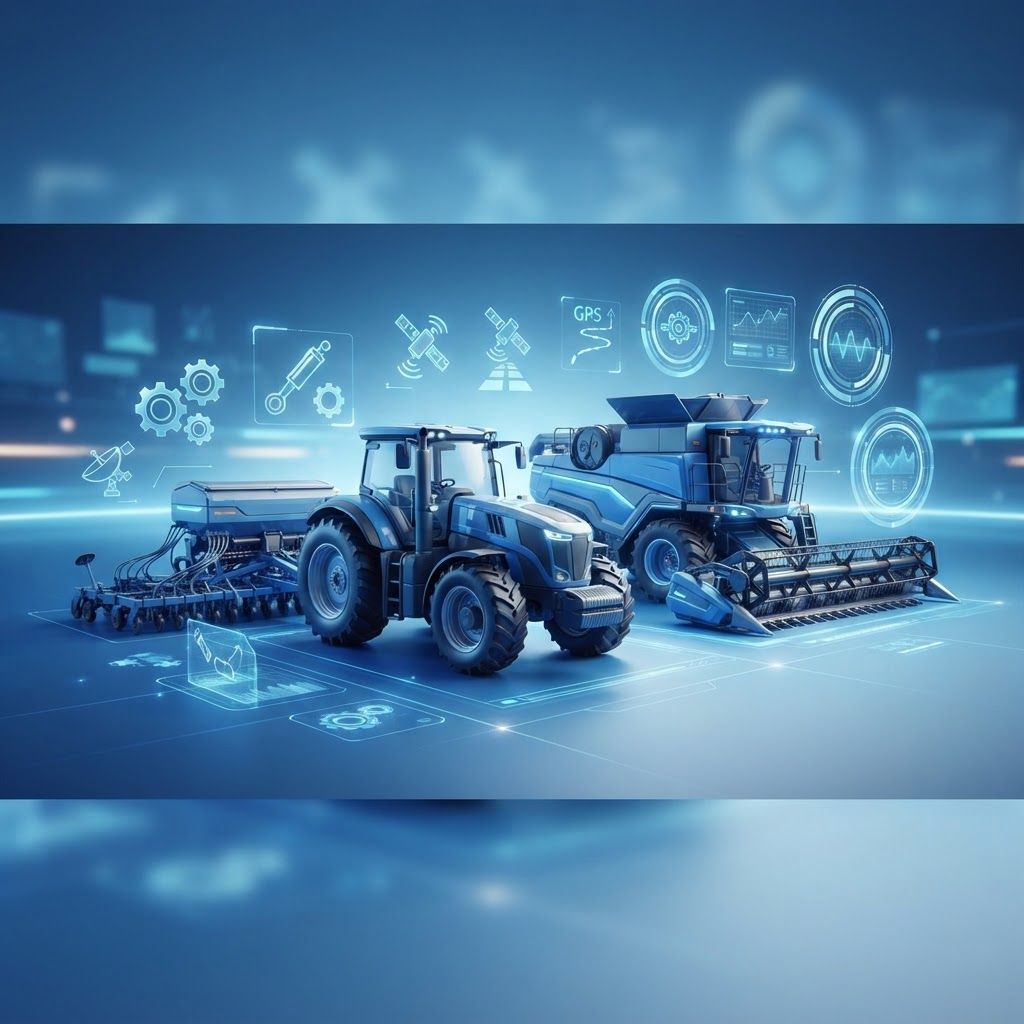
Machinery Choices That Shape Farm Performance
Few decisions affect a farm business more than machinery investment. A tractor or harvester represents a major capital commitment, ties the business to a dealer relationship for years, and determines what work can be completed in the narrow weather windows Scottish farming allows. In West Lothian, where field sizes vary, ground conditions can be heavy and holdings often combine arable with livestock, versatility and reliability matter more than headline horsepower.
The county's farmers are served by dealers based locally and across the central belt, offering the major global brands alongside specialist implement manufacturers. Increasingly the deciding factor is not the machine itself but the support behind it: parts availability, engineer response time, software support for precision systems and honest guidance on specification.
The Economics of Farm Machinery
Machinery cost per hectare is one of the most useful benchmarks in farm business analysis, and it frequently reveals overcapitalisation. Options for managing it include buying used equipment with proven reliability, extending replacement cycles where residual values hold, sharing machinery through rings or informal arrangements, using contractors for peak operations such as harvest or silage, and leasing to preserve capital. The best-performing farms tend to own what they use constantly and hire or share what they do not.
1. John Deere
John Deere is the world's largest agricultural machinery manufacturer and a benchmark for integrated technology. Its tractors, combine harvesters, sprayers and forage equipment are supported by a mature precision agriculture ecosystem covering guidance, section control, telematics and data management. For West Lothian arable growers, the appeal is a single connected platform where machines, implements and farm software communicate reliably, plus strong residual values that soften ownership cost.
2. New Holland
New Holland has a long history in the British and Scottish market and a reputation for practical, operator-friendly machinery. Its combine and baler ranges are particularly well established, and the brand has invested notably in alternative fuels, including methane-powered tractors that can run on farm-produced biomethane. That direction resonates with farms operating anaerobic digestion or seeking to cut fuel emissions.
3. Massey Ferguson
Massey Ferguson holds deep affection among British farmers and remains a strong choice for mixed and livestock farms. The brand emphasises straightforward, serviceable engineering alongside modern comfort and efficiency, which suits businesses wanting capability without unnecessary complexity. Mid-horsepower models are especially popular for the loader work, forage operations and general haulage that dominate many West Lothian farms.
4. Case IH
Case IH is known for powerful, well-built tractors and combines with strong performance in demanding conditions. Its high-horsepower models and articulated tractors serve larger arable operations and agricultural contractors, while advanced automation and guidance systems support precise field work. Contractors in central Scotland often favour the brand for durability under intensive annual hours.
5. Fendt
Fendt occupies the premium tier, offering exceptional build quality, continuously variable transmissions and advanced cab technology. The purchase price is higher, but many operators report lower running costs, superior fuel efficiency, greater operator comfort over long days and strong resale values. For farms and contractors accumulating high hours, the total cost of ownership argument can be compelling.
6. Claas
Claas is the leading name in forage harvesting, with combine harvesters, forage harvesters and balers that set standards in throughput and grain quality. Given the importance of silage to Scottish livestock farming, the brand's forage equipment is particularly relevant. Its tractor range has grown steadily, and telematics integration supports fleet monitoring for contractors managing multiple machines.
7. Kuhn
Kuhn specialises in implements rather than tractors, producing ploughs, cultivators, seed drills, mowers, tedders, rakes, diet feeders and sprayers. Implement choice determines seedbed quality, forage consistency and application accuracy, and Kuhn's breadth allows farms to match equipment precisely to soil type and system. Reliable spare parts availability through Scottish dealers is a significant practical advantage during silage and harvest.
8. JCB Agriculture
JCB is a British manufacturing success story and dominant in agricultural materials handling. Its telescopic handlers and Fastrac high-speed tractors are widely used on livestock farms and by contractors for muck handling, bale stacking, feeding and road haulage. Suspension and braking capability on the Fastrac range makes genuinely fast road travel possible, valuable where holdings are fragmented across several parcels.
9. Krone
Krone focuses on grassland and forage machinery, producing mowers, tedders, rakes, balers and forage wagons with a reputation for high output and robust construction. Big square and round balers from the brand are common on Scottish farms and contracting fleets, where reliable bale density and consistent wrapping directly affect forage quality and winter feed value.
10. Trimble and Precision Agriculture Systems
Precision technology providers supply the guidance receivers, correction services, rate controllers, soil scanners and farm management software that increasingly define equipment capability. Brand-agnostic systems allow mixed fleets to share a single guidance and mapping platform, which suits farms that have accumulated machinery from different manufacturers. Accurate application of seed, fertiliser and crop protection reduces both cost and environmental impact.
Autonomy, Electrification and Data
Three technology shifts are reshaping farm equipment. Autonomy is advancing from guidance assistance towards genuinely driverless field operations, with lightweight autonomous units offering an alternative to ever-larger machines and reducing soil compaction. Electrification is arriving first in smaller equipment, loaders and implements, with battery weight still limiting heavy field applications, though methane and hydrogen are being explored for higher power demands. Data integration is perhaps most immediately valuable, since combining yield maps, soil analysis, weather records and application data supports genuinely better decisions.
Choosing a Dealer, Not Just a Brand
Experienced farmers know the dealer often matters more than the badge. Key questions include how quickly an engineer can attend during harvest, whether parts are held in Scotland or shipped from further afield, what support exists for precision system setup and calibration, how demonstration and trial arrangements work, and what finance options are genuinely available. A slightly less prestigious brand with excellent local backup usually outperforms a premium machine with distant support.
Final Thoughts
West Lothian farms have access to the full range of world-class agricultural equipment brands through dealers across central Scotland. The right choice depends on enterprise mix, annual hours, field conditions and appetite for technology. What unites successful machinery decisions is disciplined analysis of cost per hectare, realistic assessment of utilisation, and a dealer relationship strong enough to keep equipment working when weather windows are short and the pressure is on.
Want your brand featured in front of decision-makers? Publish a guest post or get a link insertion in our guides through AAMAX's guest post and link insertion service.
Helpful Links
 SponsoredAAMAX — Full-Service Digital Agency
Write for Us
Share your expertise with our readers. We welcome guest contributions from industry specialists.
Pitch your idea

