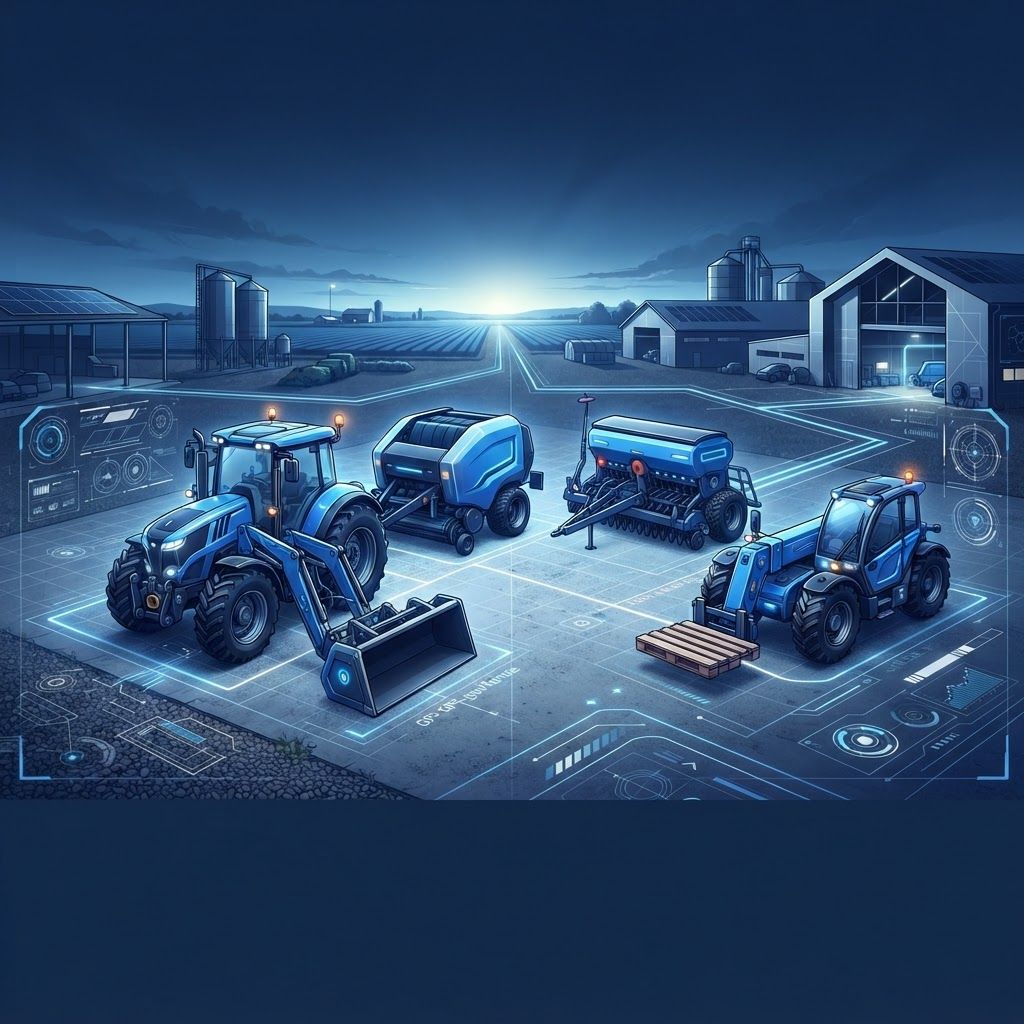
Choosing Farm Machinery for Welsh Conditions
Agricultural machinery decisions around Swansea are shaped by geography as much as by budget. This is grassland country: high rainfall, heavy soils in places, steep valley slopes to the north, and coastal fields on the Gower where salt-laden air accelerates corrosion. Equipment that performs superbly on flat, dry arable land can struggle here, and farms quickly learn that traction, weight distribution, ground pressure and corrosion resistance matter more than raw horsepower figures.
Field size is another consideration. Many holdings around Swansea work smaller, irregular fields bounded by hedgerows and stone walls, accessed by narrow lanes. Compact dimensions, tight turning circles and manoeuvrability often outweigh sheer capacity, and oversized machinery can become a liability rather than an asset. The best-regarded brands locally are those that combine durability with practical sizing and, crucially, strong dealer support within reasonable reach.
What Really Determines Machinery Value
Purchase price is only the beginning. Total cost of ownership includes fuel or energy use, servicing, wear parts, downtime and eventual resale value. A tractor that costs more initially but holds strong residual value and can be serviced quickly by a nearby dealer frequently works out cheaper across its working life than a bargain machine with poor parts availability.
Dealer support is arguably the decisive factor in a region like this. During silage or harvest windows dictated by narrow weather opportunities, a breakdown lasting three days can cost far more than the price difference between brands. Farms therefore weigh parts stock, engineer availability, loan machine policies and response times heavily when choosing.
Operator comfort and safety deserve more attention than they often get. Long hours on slopes demand good visibility, stable handling, effective braking and a cab that reduces fatigue. Safety features on loaders, PTO guards and roll protection are essential, not optional, given agriculture's serious injury record.
Top 10 Best Agricultural Equipment Brands in Swansea
1. John Deere — Globally recognised for tractors, mowers and precision agriculture technology. Widely valued for build quality, advanced guidance systems and strong residual values, with technology that suits farms investing in data-led grassland management.
2. New Holland — A long-standing favourite on Welsh livestock farms, offering tractors, balers and forage equipment. Reputation rests on practical mid-range models, comfortable cabs and well-proven baler designs suited to grass and silage work.
3. Massey Ferguson — Deeply established in UK farming with a broad tractor range including compact and mid-power models well matched to smaller Gower and valley holdings. Known for straightforward serviceability and dependable performance.
4. Case IH — Offers robust tractors and harvesting machinery with a reputation for durability under heavy workloads. Popular with larger holdings and agricultural contractors working across multiple farms.
5. Fendt — A premium brand known for continuously variable transmissions, precision engineering and operator comfort. Often chosen by farms prioritising efficiency, low fuel consumption and long service life over lowest initial cost.
6. Kubota — Particularly strong in compact tractors, utility vehicles and groundcare machinery. Well suited to smallholdings, market gardens, equestrian businesses and estate maintenance where a full-size tractor would be impractical.
7. Claas — Highly regarded for forage harvesting, mowers, balers and telehandlers. Their grassland equipment is especially relevant in a region where silage quality directly determines livestock performance.
8. JCB — A British manufacturer known for telehandlers, loadalls and high-speed tractors. Telehandlers have become near-essential on modern livestock farms for bale handling, feeding, muck work and general yard duties.
9. Krone — Specialists in grassland machinery including mowers, tedders, rakes and balers. Frequently chosen by contractors and larger farms for high output and consistent bale quality in variable Welsh weather windows.
10. McHale — An Irish manufacturer focused on baling and wrapping equipment, designed with wet-climate grass systems in mind. Their combination baler-wrappers are well matched to the short, unpredictable dry windows common in South Wales.
Technology Trends in Agricultural Equipment
Precision agriculture has moved firmly into grassland farming. GPS guidance, section control on fertiliser spreaders, yield and moisture sensing on forage equipment and variable-rate application reduce input waste while improving consistency. On smaller Welsh farms, even simple guidance and mapping tools deliver measurable savings.
Telematics and connected servicing are becoming standard on new machinery. Remote diagnostics allow dealers to identify faults before a machine stops working, and usage data supports planned maintenance rather than reactive repair — particularly valuable when downtime coincides with a narrow weather window.
Alternative power is developing steadily. Electric compact tractors and utility vehicles are already practical for yard work, feeding and horticulture, while larger machines are exploring biomethane, hydrogen and hybrid drivetrains. Adoption will be gradual, but reduced noise, lower running costs and zero local emissions are attractive for enclosed livestock buildings.
Automation is emerging through autonomous mowers, robotic feed pushers and increasingly capable milking robots, addressing persistent labour shortages in agriculture.
Practical Buying Advice
Match machinery to your actual workload and terrain rather than to aspiration. Calculate the hours a machine will genuinely work, the slopes it must handle safely and the ground conditions it will face. Tyre choice and ballasting often improve performance more cost-effectively than upgrading to a larger model.
Assess dealer capability before brand loyalty. Ask about parts stock, engineer numbers, average response times in peak season and whether loan machines are available. Speak to neighbouring farms about their real experiences, which tend to be more revealing than any brochure.
Consider used and contractor options seriously. Well-maintained used machinery with documented service history offers strong value, and hiring a contractor for specialist tasks such as forage harvesting can be far more economical than owning equipment used a few days each year.
Finally, factor in training and safety. New technology only pays back when operators understand it, and time invested in proper instruction reduces both breakdowns and accidents. For farms around Swansea working challenging land in unpredictable weather, reliable, well-supported and appropriately sized machinery will always outperform the biggest specification on paper.
Want your brand featured in front of decision-makers? Publish a guest post or get a link insertion in our guides through AAMAX's guest post and link insertion service.
Helpful Links
 SponsoredAAMAX — Full-Service Digital Agency
Write for Us
Share your expertise with our readers. We welcome guest contributions from industry specialists.
Pitch your idea