

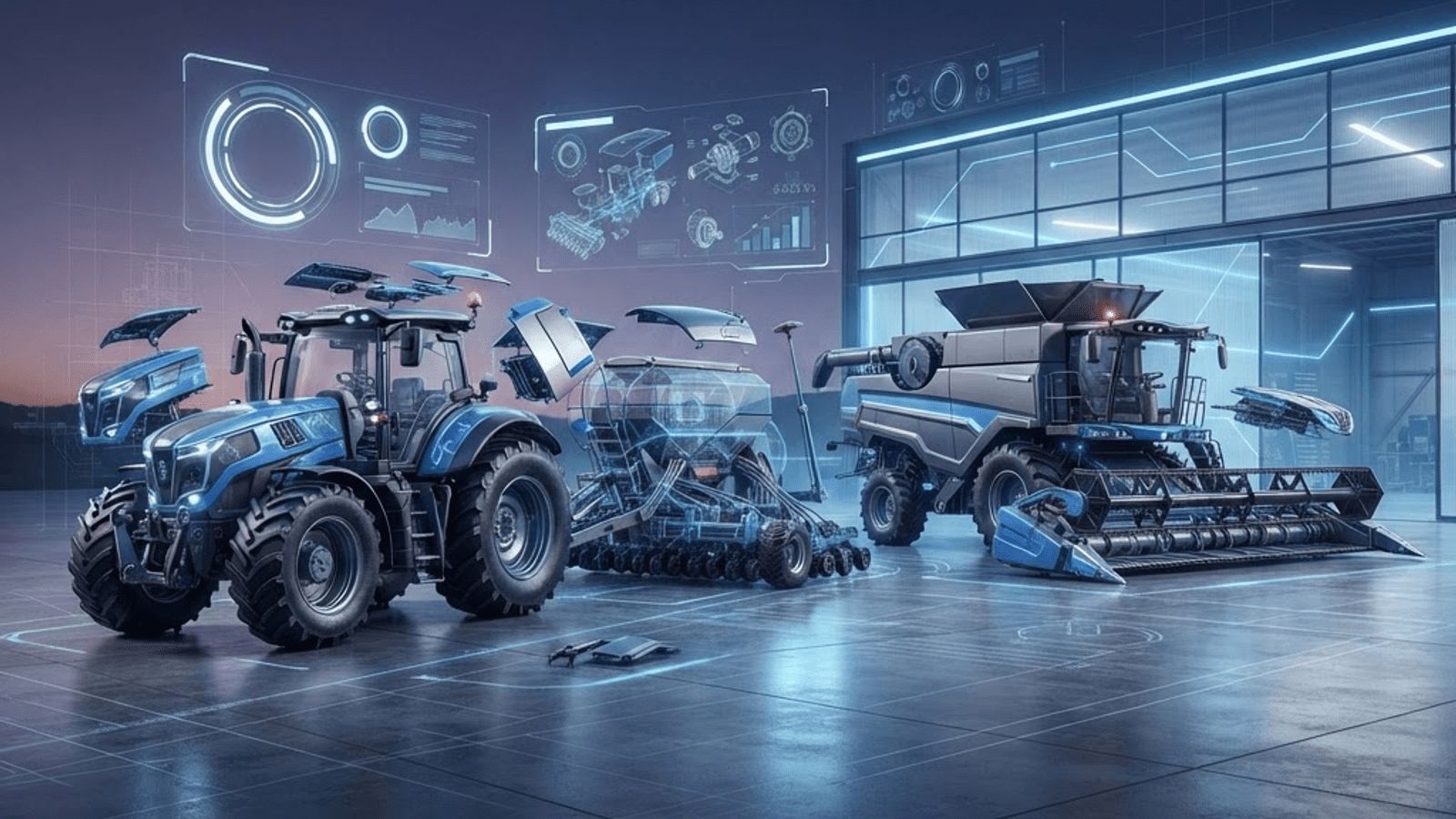
Machinery and the Economics of Hertfordshire Farming
Agricultural machinery represents the largest capital commitment most farming businesses make. A modern tractor with front loader can exceed the cost of a substantial house, and a combine harvester considerably more. For farms around St Albans, where land values are high and holdings are often smaller than in the eastern counties, getting machinery decisions right has an outsized effect on profitability.
The local context shapes buying patterns distinctly. Field sizes across Hertfordshire are generally moderate rather than vast, and many holdings sit close to residential areas and busy roads. This favours machinery that is manoeuvrable, road-legal without excessive escorting, and versatile enough to handle several tasks rather than specialising narrowly. It also explains why contract farming and machinery sharing are common locally, spreading the cost of high-capacity equipment across more acres than any single farm could justify.
What Farmers Actually Evaluate
Purchase price attracts attention but rarely determines the decision. Experienced buyers focus on total cost of ownership, which combines depreciation, fuel efficiency, maintenance costs, dealer support quality and eventual residual value. A machine that costs more initially but holds its value and receives fast local parts support frequently proves cheaper across a decade of use.
Dealer proximity matters enormously. During harvest a breakdown lasting two days can cost more in lost crop quality than a year of finance payments. Farmers therefore weight local dealer strength heavily, sometimes choosing a brand primarily because the nearest dealership holds strong parts stock and employs responsive field engineers.
The Leading Agricultural Equipment Brands Serving St Albans
John Deere holds a commanding reputation across arable farming and is widely used on larger Hertfordshire holdings. Its strength lies in an integrated technology ecosystem covering guidance, telematics, variable-rate application and data management, allowing a whole fleet to operate within one connected system. Build quality and strong residual values support the premium pricing.
New Holland is a longstanding presence on British farms and particularly well represented in mixed farming operations. Its tractor range spans compact to high-horsepower models, and its combines have a solid reputation in variable UK harvest conditions. Many farmers cite operator comfort and straightforward serviceability as decisive factors.
Massey Ferguson retains deep loyalty among British farmers, especially on family holdings where the brand has been used across generations. Its appeal centres on mechanical simplicity in mid-range models, competitive pricing and a dealer network with genuine agricultural depth rather than showroom polish.
Case IH is respected for high-horsepower tractors and combine harvesters, popular among contractors covering large areas across Hertfordshire and neighbouring counties. Its Axial-Flow combine design has a strong reputation for grain sample quality, which directly affects the price a crop achieves.
Fendt occupies the premium end of the market and appeals to operations prioritising fuel efficiency, precision and operator environment. The continuously variable transmission technology it pioneered delivers measurable efficiency gains, and for high-hour operations those savings can justify the higher purchase cost.
Claas is exceptionally strong in harvesting machinery, with combines and forage harvesters widely regarded as class-leading. Its tractor range has grown steadily in UK market share, and contractors in the region value the throughput its harvesting equipment achieves in narrow weather windows.
Kubota dominates the compact and utility tractor segment, which matters greatly around St Albans where smallholdings, equestrian yards, market gardens, estates and groundcare operations are numerous. Reliability, compact dimensions and excellent manoeuvrability suit the diverse small-acreage land use characteristic of the district.
JCB brings British manufacturing strength and is essentially standard equipment for materials handling on farms. Telescopic handlers have transformed farmyard work, and JCB's Fastrac tractors offer road speeds that suit the fragmented holdings and long road runs common in Hertfordshire.
Vaderstad specialises in cultivation and drilling equipment and has become influential as farmers adopt reduced tillage. Its drills perform well in the min-till and direct-drilling systems increasingly used across the region to protect soil structure and cut establishment costs.
Kuhn supplies a broad implement range covering ploughs, cultivators, sprayers, mowers and spreaders. For mixed operations needing quality implements across several tasks, a single implement supplier simplifies parts supply and dealer relationships considerably.
Precision Technology Has Changed the Machinery Conversation
Modern agricultural equipment functions as a data platform as much as a mechanical tool. GPS guidance with RTK correction achieves accuracy within a couple of centimetres, eliminating overlap on every pass. Across a season this alone saves meaningful fuel, seed, fertiliser and chemical volumes while reducing operator fatigue substantially.
Section control shuts off sprayer booms or seeding units automatically at headlands and around obstacles. Variable-rate technology adjusts application rates continuously according to soil mapping or live crop sensing. Yield mapping from combines produces detailed field performance data that informs the following season's decisions. Telematics transmits machine performance and location data, letting managers monitor a fleet remotely and letting dealers diagnose faults before dispatching an engineer.
The Right to Repair Question
Increasing machinery complexity has created genuine tension around repairability. Modern tractors depend on proprietary diagnostic software, and some functions cannot be restored without authorised dealer intervention. Farmers who once repaired their own equipment now find themselves waiting for a dealer visit over a fault that is fundamentally electronic rather than mechanical.
This has real cost implications during time-critical operations. Some manufacturers have responded by improving access to diagnostic tools and documentation. Prudent buyers now investigate parts availability, diagnostic access and dealer response commitments before purchase, treating serviceability as a specification item rather than an afterthought.
Used Machinery and Alternative Access Models
Not every farm needs new equipment. The used market is deep and well served by dealers across the region, and a well-maintained machine at five to seven years old often represents the best value point, having absorbed the steepest depreciation while retaining substantial working life.
Machinery rings and sharing arrangements are common in Hertfordshire, allowing several farms to access high-capacity equipment collectively. Contract farming agreements go further, with a contractor supplying all machinery and labour while the landowner retains the cropping enterprise. Leasing and contract hire have also grown, converting a large capital outlay into predictable operating cost with maintenance included.
Where Farm Machinery Is Heading
Autonomy is advancing steadily, with driverless implements already operating commercially in some contexts. Smaller autonomous units working continuously may eventually challenge the assumption that bigger machinery is always better, particularly on the moderate field sizes typical of Hertfordshire.
Electrification is progressing in compact machinery and materials handling, where duty cycles suit battery capability. Alternative fuels including hydrotreated vegetable oil offer emissions reductions in existing engines without replacement. Meanwhile robotic weeding and targeted spraying systems using camera recognition promise substantial reductions in herbicide use, an increasingly valuable capability as chemical approvals narrow.
Final Thoughts
Agricultural equipment serving St Albans reflects a diverse local farming sector, from high-horsepower arable machinery to compact tractors for smallholdings and estates. The brands that succeed combine mechanical reliability with credible technology and, crucially, strong local dealer support. For farmers and contractors in the district, matching machine capability honestly to acreage, soil type and workload remains the most reliable route to profitable mechanisation.
Want your brand featured in front of decision-makers? Publish a guest post or get a link insertion in our guides through AAMAX's guest post and link insertion service.
Helpful Links
 SponsoredAAMAX — Full-Service Digital Agency
Write for Us
Share your expertise with our readers. We welcome guest contributions from industry specialists.
Pitch your idea

