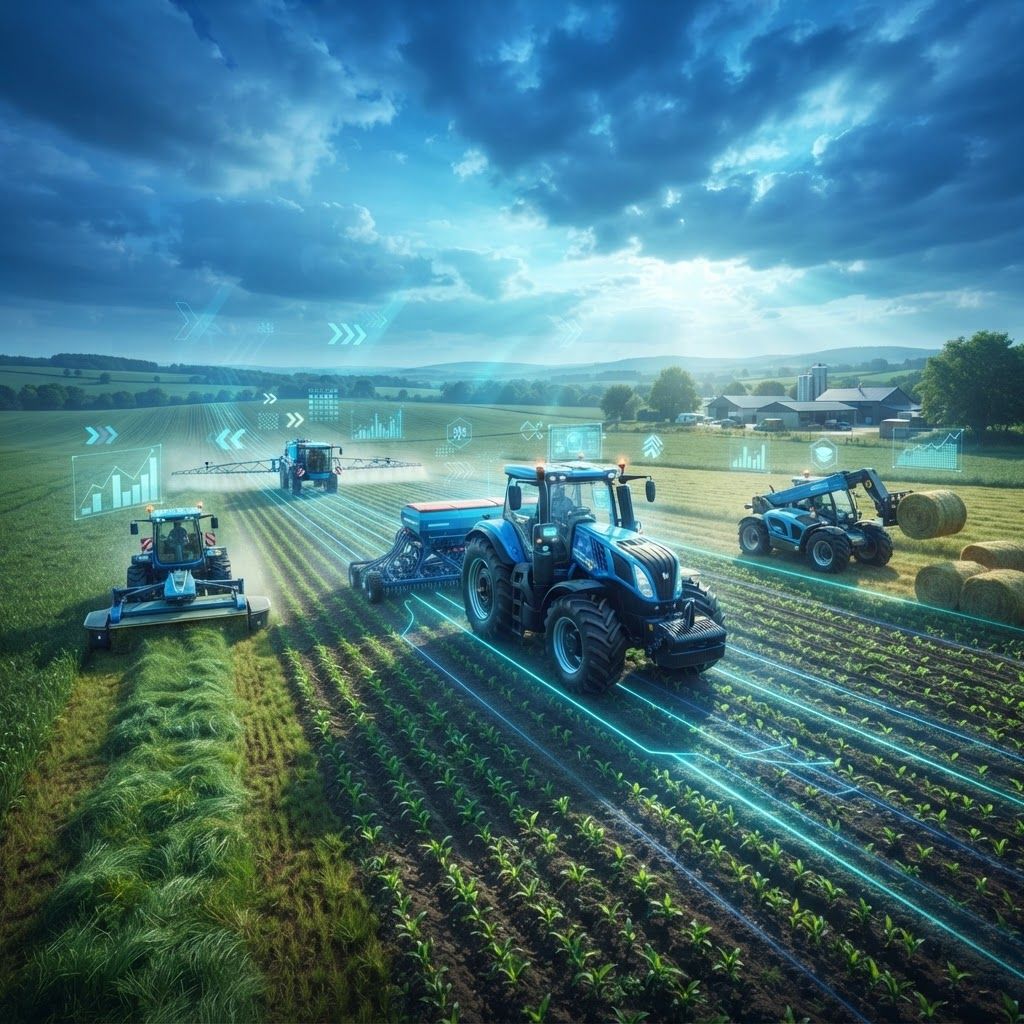
Machinery Decisions That Shape a Farm Business
Agricultural equipment represents one of the largest capital commitments a farm makes. A tractor, forage harvester or precision drill will work for a decade or more, and its performance affects timeliness, fuel use, soil condition and labour requirement across every season. In Lancashire's climate, where weather windows for silage, harvest and cultivation can be narrow, reliability and local support often matter more than headline specification.
Farms around Preston operate across dairy, livestock, arable and horticulture, and each requires different machinery emphasis. Dairy farms prioritise grassland equipment, forage harvesting, slurry handling and materials handling. Arable operations focus on cultivation, drilling, spraying and combining. Horticultural growers on the Fylde need precision planting, irrigation and harvesting equipment quite unlike general farm machinery.
The Top 10 Agricultural Equipment Brands and Suppliers Serving Preston
1. Ribble Tractor and Machinery — A main dealer supplying tractors across the horsepower range with continuously variable transmissions, front linkage options and integrated guidance systems. Ribble Tractor and Machinery is valued less for the machines themselves than for its parts stock and mobile service fleet, which determines how quickly a breakdown is resolved during silage or harvest.
2. Preston Grassland Equipment — Specialists in mowers, tedders, rakes, balers and wrappers for grass and forage. Grassland machinery quality directly determines silage quality, and their advice on mower conditioner settings, wilting and chop length has a measurable effect on forage analysis results and therefore on milk from forage.
3. Lancashire Slurry and Muck Handling — Suppliers of slurry tankers, umbilical systems, dribble bars, trailing shoe applicators and separators. Regulation has pushed the industry away from splash plate spreading towards low-emission application, and their equipment allows farms to retain more nitrogen from slurry while meeting compliance requirements, reducing purchased fertiliser.
4. Deepdale Arable Cultivation Systems — Providing ploughs, min-till cultivators, direct drills, power harrows and rollers. Establishment method is one of the most consequential agronomic decisions a farm makes, and Deepdale Arable Cultivation Systems supports customers with demonstration days that allow machines to be tested in local soil conditions rather than judged from a brochure.
5. Fylde Precision Horticultural Machinery — Specialising in equipment for vegetable and salad production: bed formers, precision seeders, transplanters, inter-row hoes and harvesting aids. Camera-guided mechanical weeding has become genuinely viable and reduces herbicide reliance substantially, which matters as active ingredient approvals continue to be withdrawn.
6. Broughton Materials Handling and Telehandlers — Supplying telescopic handlers, loading shovels, compact loaders and attachments for farm yards. Handling equipment is used every single day on livestock farms and its reliability and visibility directly affect both efficiency and safety, an area where farming has a poor accident record that better equipment helps address.
7. Northern Livestock Equipment — Manufacturers and suppliers of cattle crushes, race systems, sheep handling equipment, feed barriers, cubicles and mats. Well-designed handling systems reduce stress on both stock and staff, improve the accuracy of routine tasks such as weighing and dosing, and significantly reduce injury risk.
8. Guild Agricultural Sprayers and Application — Providing mounted, trailed and self-propelled sprayers with section control, individual nozzle shut-off and rate mapping. Application accuracy is both an economic and regulatory issue, and their sprayer testing service supports compliance with mandatory inspection requirements while confirming that machines apply what the operator intends.
9. Penwortham Agri-Tech and Guidance Systems — Suppliers and installers of satellite guidance, automatic steering, section control, yield mapping and farm management software. Retrofit guidance on existing machinery frequently pays back within a season through reduced overlap on fertiliser and spray, making it one of the most accessible technology investments available to smaller farms.
10. Avenham Used Farm Machinery — Dealing in inspected and serviced second-hand tractors, trailers and implements with warranty options. For many Lancashire farms, well-maintained used machinery with local parts support delivers better return on capital than new equipment, and honest condition assessment is what distinguishes a reputable dealer in this market.
How to Evaluate Agricultural Equipment Properly
Dealer support should carry more weight in the decision than most buyers give it. Ask specifically about parts availability, whether parts are held locally or nationally, the size of the service engineering team, response times during peak season and whether out-of-hours support is available. A marginally superior machine with weak support will cost far more in lost days than it saves in specification.
Second, calculate cost per hectare or per hour rather than comparing purchase prices. Include depreciation, finance, fuel, repairs and expected residual value. Fuel consumption differences between tractors of similar power can be substantial over a thousand hours of annual work.
Third, consider whether ownership is even the right model. Contractor hire, machinery rings and shared ownership give access to modern high-capacity equipment without the capital burden, and for machines used only a few days a year the economics almost always favour hiring.
Technology Worth Investing In
Guidance and section control offer the clearest returns by eliminating overlap and missed areas. Variable rate application matched to soil sampling reduces fertiliser use while maintaining yield. Telematics allow remote monitoring of machine performance and fuel use, and increasingly support predictive maintenance. Low-emission slurry application both meets regulation and captures nutrient value. Data integration linking machinery output to farm management software turns operational records into decision-making information rather than paperwork.
Autonomous and lightweight robotic field machinery is progressing quickly, particularly in horticulture where labour scarcity is acute. It is not yet mainstream, but growers around the Fylde are among the earliest UK adopters and worth watching.
Safety and Compliance
Agriculture remains one of the most dangerous industries in the UK, with machinery involved in a high proportion of serious incidents. Power take-off guarding, safe stop procedures, correct hitching, roll-over protection and adequate lighting on road-going equipment are basic requirements. Sprayers require mandatory periodic testing, operators need appropriate certification, and lifting attachments on telehandlers require thorough examination. Reputable suppliers raise these matters proactively.
Final Thoughts
The best agricultural equipment brand for a Preston farm is the one whose machines suit local conditions and whose dealer answers the phone at six on a Saturday evening during silage. Specify against your actual workload, demand a working demonstration on your own land, calculate lifetime cost honestly and weight local support heavily. Lancashire farms that apply this discipline consistently achieve better machinery utilisation and fewer costly delays than those buying on specification sheets alone.
Want your brand featured in front of decision-makers? Publish a guest post or get a link insertion in our guides through AAMAX's guest post and link insertion service.
Helpful Links
 SponsoredAAMAX — Full-Service Digital Agency
Write for Us
Share your expertise with our readers. We welcome guest contributions from industry specialists.
Pitch your idea