

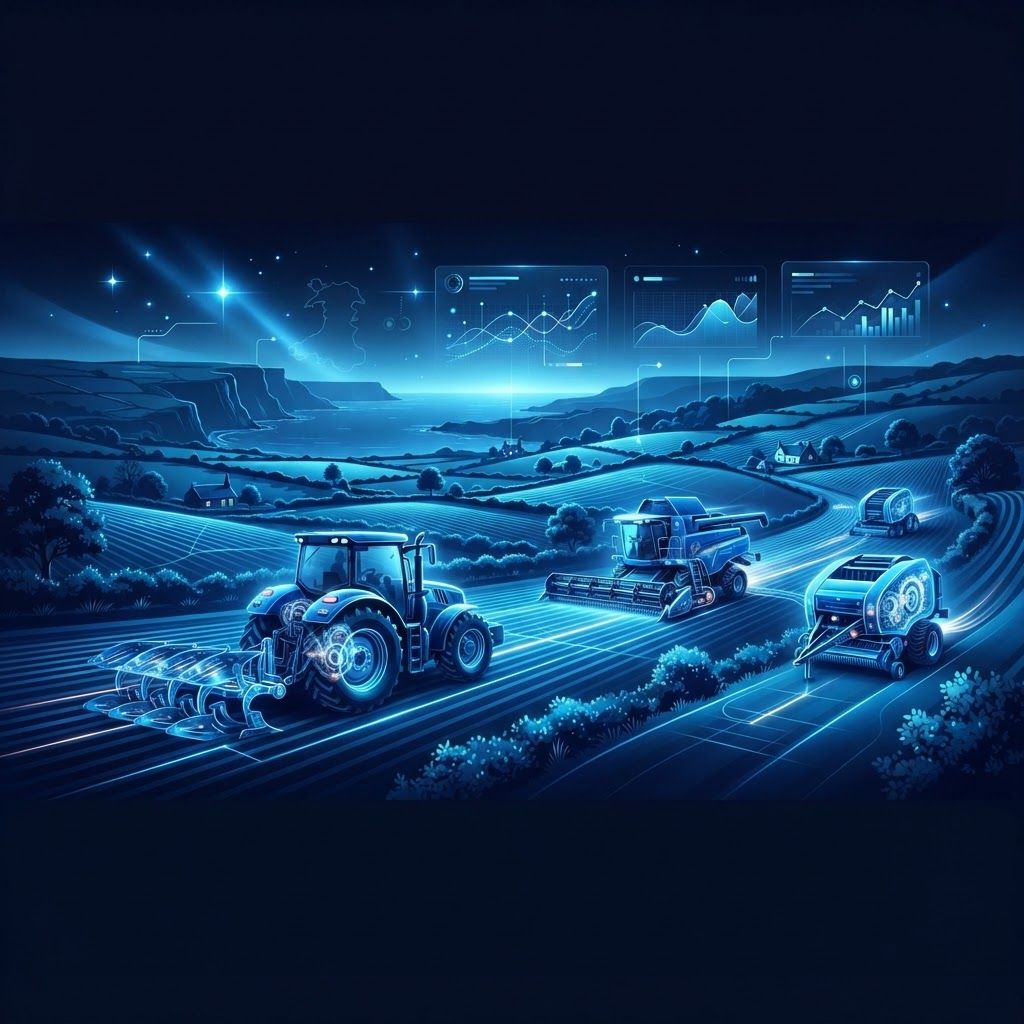
Machinery in a Grass-Dominated Farming County
Agricultural machinery requirements are shaped by farming systems, and Pembrokeshire's systems are dominated by grass. Dairy, beef and sheep enterprises across the county need mowers, tedders, rakes, balers, wrappers and forage harvesting capacity, alongside slurry handling equipment that is increasingly scrutinised for environmental performance. Arable and potato growers add cultivation, drilling, spraying and harvesting machinery to the mix.
Two local factors influence machinery choice heavily. The first is field size and access. Many Pembrokeshire fields are modest, bounded by traditional hedgebanks, and reached along narrow lanes. Very large machinery can be impractical regardless of its theoretical output. The second is weather. Wet conditions compress working windows, so farms often favour capacity that lets them complete operations quickly when conditions allow, and tyre and tracking choices that reduce soil compaction.
How to Choose Agricultural Equipment Well
Dealer support is more important than brand prestige. A machine from a well-regarded manufacturer with no local dealer is a liability during silage season, when a breakdown of even a day can cost a crop. Always ask where the nearest service engineer is based and what the response commitment is during peak periods.
Parts availability follows directly. Established dealers hold consumable wear parts locally: knives, tines, belts, filters and bearings. Confirm this rather than assuming.
Residual value deserves genuine consideration. Some brands hold value considerably better in the Welsh market, which matters greatly if machinery is replaced on a regular cycle.
Match capacity to the actual workload rather than to aspiration. Over-specified machinery carries depreciation and finance cost that small acreages cannot absorb, and contractor hire is frequently the better economic answer for occasional operations.
Finally, consider operator comfort and simplicity. Machinery that is complicated to set up is set up badly, and long days in an uncomfortable cab lead to mistakes.
Ten Agricultural Equipment Suppliers and Brands in the County
Cleddau Tractor and Machinery Sales operates as a full-service dealership covering tractors, loaders and implements, with workshop facilities, field service vans and parts stock geared to the local farming calendar.
Preseli Grassland Machinery specialises in the forage chain, supplying mowers, tedders, rakes, balers and wrappers, and offering pre-season servicing that prevents breakdowns during the critical silage window.
Haven Agricultural Engineering combines machinery supply with fabrication and repair, building and modifying handling equipment, feeders and trailers to suit individual farm layouts.
Landsker Slurry and Manure Systems focuses on the increasingly regulated area of nutrient handling, supplying tankers, umbilical systems, trailing shoe applicators, separators and storage solutions that support compliance and better nutrient use.
Pembrokeshire Precision Farming Technology supplies guidance systems, section control, yield mapping, variable rate application and farm management software, helping growers reduce input waste and improve field records.
West Wales Livestock Handling Equipment provides cattle crushes, races, sheep handling systems, weigh platforms and electronic identification readers designed to make stock work safer and faster for small teams.
Narberth Harvest and Arable Machinery serves the cereal and potato sectors with drills, cultivators, sprayers, harvesters and grain handling equipment, including seasonal hire options.
Milford Farm Vehicle and Trailer Supplies distributes trailers, utility vehicles, quad bikes and ancillary transport equipment, with servicing and safety inspection support.
Saundersfoot Dairy Equipment Services covers parlour installation, automated milking, cooling, cleaning systems and herd monitoring technology, with the emergency response capability that milking operations require.
Pembrokeshire Machinery Ring and Contracting operates a sharing and contracting model, giving farms access to high-capacity equipment and skilled operators without the capital burden of ownership.
Trends in Agricultural Machinery
Precision technology has moved from novelty to expectation. Guidance reduces overlap, section control cuts input waste, and yield and soil data support variable rate decisions. On a grass farm, the biggest wins are often in fertiliser and slurry application accuracy.
Slurry application regulation is driving significant investment. Low-emission spreading equipment such as trailing shoes and injectors reduces ammonia loss and improves nitrogen capture, delivering both compliance and agronomic benefit.
Alternative power is emerging slowly. Battery-electric handlers and utility vehicles are practical now, while hydrogen and biomethane tractors remain at demonstration stage for most farms.
Automation is progressing fastest in the dairy sector, where robotic milking, automatic feed pushers and herd monitoring collars reduce labour dependence, which is the binding constraint on many Pembrokeshire holdings.
Machinery costs have risen substantially, pushing farms towards longer replacement cycles, shared ownership, machinery rings and greater use of contractors.
Practical Advice for Farm Buyers
Calculate cost per hectare or per bale rather than comparing purchase prices. Depreciation, finance, fuel, repairs and labour together tell the real story.
Demonstrate machinery on your own ground before buying. Performance on a flat demonstration field says little about behaviour on a steep, wet Pembrokeshire slope.
Service before the season, not during it. Pre-season workshop slots are cheaper, available and far less disruptive than emergency repairs in June.
Standardise hydraulic and electronic interfaces where possible so implements move easily between tractors.
Consider contracting honestly for operations performed only a few days a year. Ownership pride is expensive when a machine works twenty hours annually.
Final Thoughts
Agricultural equipment decisions in Pembrokeshire should be driven by dealer support, field practicality and genuine cost per unit of work rather than by brand loyalty alone. With grass at the heart of the county's farming and environmental regulation tightening around nutrient management, investment in the forage chain and in accurate slurry application offers some of the strongest returns available to local farm businesses.
Want your brand featured in front of decision-makers? Publish a guest post or get a link insertion in our guides through AAMAX's guest post and link insertion service.
Helpful Links
 SponsoredAAMAX — Full-Service Digital Agency
Write for Us
Share your expertise with our readers. We welcome guest contributions from industry specialists.
Pitch your idea

