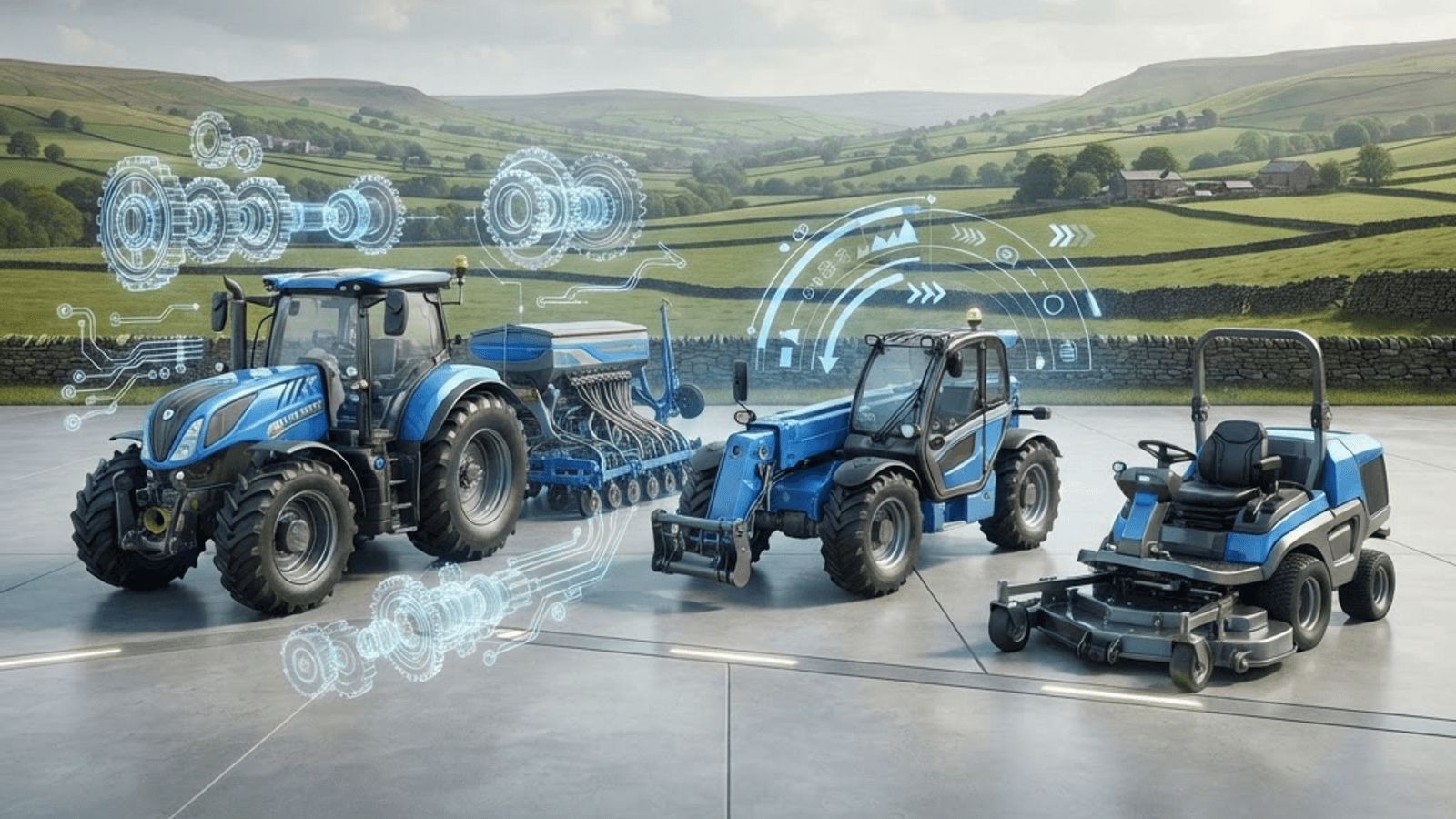
Machinery for Upland and Urban Fringe Farming
Agricultural machinery requirements around Oldham differ considerably from those of lowland arable regions. The steep, often wet Pennine ground east of the town demands compact, manoeuvrable and stable equipment rather than the large-scale kit suited to flat open fields. Narrow lanes, tight gateways and stone-walled enclosures reinforce that preference. As a result, the equipment brands and dealers thriving here are those understanding upland practicalities.
The customer base is also broader than pure commercial farming. Alongside livestock and grassland farms, dealers serve equestrian businesses, smallholders, groundcare contractors, local authority land teams and conservation organisations. That mix has encouraged suppliers to carry compact tractors, ATVs, groundcare machinery and grassland implements alongside conventional farm equipment.
What Matters When Choosing Farm Equipment
Purchase price is rarely the deciding factor for experienced buyers. Parts availability and local service support usually matter more, because a machine immobilised during silage or lambing costs far more in lost time than any initial saving. Buyers should ask directly about parts stockholding, engineer availability and typical response times before committing.
Suitability to terrain is equally critical. Low centre of gravity, appropriate tyre options, adequate hydraulic capacity and manoeuvrability all determine whether a machine performs safely on sloping ground. Residual value deserves consideration too, as brands with strong reputations hold value considerably better, which affects the true cost of ownership. Finally, operator comfort and safety features reduce fatigue and accident risk during long working days.
1. Pennine Tractor and Machinery Company
Pennine Tractor and Machinery Company is a leading dealer serving farms across Oldham and the surrounding Pennine districts, supplying compact and mid-range tractors together with a broad implement range. Its focus on machines suited to hill farming rather than large arable equipment reflects genuine understanding of local needs.
Aftersales strength is the recurring theme in customer feedback. Substantial parts stockholding, mobile service engineers and a workshop capable of major repairs mean downtime is minimised. The company also offers demonstration on customers' own land, which is far more informative than a dealership yard trial on flat concrete.
2. Oldham Grassland Equipment Specialists
Given that grass is the dominant crop across the borough's farmland, Oldham Grassland Equipment Specialists occupies an important niche. Its range covers mowers, tedders, rakes, balers, wrappers, harrows, aerators and reseeding equipment designed for forage production.
Technical guidance on forage conservation distinguishes the business. Staff advise on cutting height, conditioning and wilting to maximise silage quality, recognising that machinery choice directly influences feed value. Seasonal servicing programmes before the silage season help ensure equipment is ready when the weather window opens.
3. Saddleworth Compact Tractors and ATVs
Saddleworth Compact Tractors and ATVs serves smallholders, equestrian businesses and hill farms needing small, agile machines. Compact tractors, quad bikes, side-by-side utility vehicles and matched implements form the core offer.
The business excels at matching machine to task, helping customers avoid the common mistakes of buying underpowered kit that struggles or oversized equipment that damages ground and cannot access tight areas. Safety training on ATV use is also provided, addressing a category with a genuinely serious accident record on farms.
4. Greater Manchester Livestock Handling Systems
This supplier specialises in the equipment that makes livestock work safer and more efficient, including cattle crushes, sheep handling systems, race and gate systems, weighing equipment and mobile handling units. Its customers are the sheep and beef farms that dominate Oldham's agricultural land.
Safety and welfare benefits drive purchasing decisions here. Well-designed handling systems dramatically reduce injury risk to both stock and handlers while cutting the labour needed for routine tasks such as dosing, foot trimming and weighing. Mobile options suit farms working across fragmented land parcels, a common upland situation.
5. Chadderton Agricultural Engineering and Fabrication
Chadderton Agricultural Engineering and Fabrication combines equipment supply with bespoke fabrication and repair. When a standard implement does not quite suit a particular farm layout or task, the business designs and builds a solution.
This capability holds real value on upland farms where standard equipment often needs modification. The workshop also undertakes structural repairs, hydraulic work and welding on existing machinery, extending working life considerably. In an era of high new machinery prices, competent repair is an increasingly attractive alternative to replacement.
6. Royton Farm Machinery Sales and Service
Royton Farm Machinery Sales and Service focuses on the used equipment market, sourcing, refurbishing and warranting second-hand tractors and implements. For many smaller farms, quality used machinery represents far better value than new.
Transparency underpins its reputation. Machines are inspected and refurbished before sale, with condition honestly described and warranty provided on major components. The business also takes trade-ins and buys equipment outright, giving farms a straightforward route to upgrading or disposing of surplus machinery.
7. Failsworth Groundcare and Estate Machinery
Serving the boundary between agriculture and land management, Failsworth Groundcare and Estate Machinery supplies ride-on mowers, flail mowers, chippers, brushcutters, hedge trimmers and estate maintenance equipment. Customers include contractors, sports grounds, local authorities and conservation bodies.
The business understands the specific requirements of amenity and conservation management, where finish quality and habitat sensitivity matter as much as raw output. Battery-powered options across handheld and smaller machines have expanded significantly, appealing to organisations working near housing or with noise and emissions commitments.
8. Lees Precision Farming Technology
Lees Precision Farming Technology supplies and supports the digital layer of modern agriculture, including GPS guidance, yield and grass measurement, livestock monitoring systems, electronic identification readers and farm management software.
Practical implementation support is the key differentiator. Precision technology delivers value only when properly configured and actually used, and the business provides setup, training and ongoing support rather than simply selling hardware. Livestock monitoring has proven especially valuable locally, with electronic identification enabling performance recording that materially improves flock and herd management.
9. Diggle Irrigation and Water Systems
Diggle Irrigation and Water Systems addresses the increasingly important area of farm water management, supplying troughs, pumps, pipework, storage tanks, rainwater harvesting systems and remote monitoring. Reliable livestock water supply across scattered upland fields is a persistent practical challenge.
Remote monitoring has been a notable advance, alerting farmers to trough failures or supply problems without requiring daily physical checks across difficult terrain. That saves considerable time and prevents the serious welfare consequences of stock going without water. Rainwater harvesting also reduces mains dependence and cost.
10. Oldham Agricultural Safety and Equipment Hire
Oldham Agricultural Safety and Equipment Hire provides short-term access to specialist machinery alongside safety equipment and protective gear. Hire makes economic sense for equipment needed only occasionally, such as post drivers, stone burying machines, specialist seeders or lifting equipment.
The hire model suits smaller farms and smallholders particularly well, providing access to capable equipment without the capital cost and storage burden of ownership. Well-maintained fleet condition and clear operating guidance are consistently praised by customers.
Servicing, Maintenance and Managing Downtime
Preventive maintenance delivers far better returns than reactive repair. Adhering to service intervals, replacing filters and fluids on schedule, greasing correctly and addressing small issues promptly all extend machine life significantly. Farms with disciplined maintenance routines consistently report lower total ownership costs than those running equipment until failure.
Timing matters in seasonal agriculture. Servicing forage equipment in late winter, before the silage season, avoids competing for engineer availability at the busiest time. Keeping critical consumables and commonly failing parts on the shelf can convert a multi-day breakdown into a short interruption, which during a narrow weather window is genuinely decisive.
Technology Trends in Farm Machinery
Electrification is progressing steadily, most visibly in handheld tools, ATVs and compact machines where battery technology now meets duty requirements. Larger machines remain diesel-dominated, though hybrid systems and alternative fuels are advancing. For Oldham's smaller farms, electric compact equipment is already practical and offers lower running costs alongside reduced noise.
Automation and guidance continue to spread, though upland terrain and irregular field shapes limit some applications. More relevant locally are data and monitoring technologies, where livestock sensors, grassland measurement and integrated farm software deliver clear returns regardless of field size or slope.
Machinery sharing and contracting also continue to grow. With new equipment costs high and utilisation on smaller farms low, sharing arrangements between neighbouring farms and greater use of contractors increasingly make more financial sense than individual ownership of every implement.
Buying Advice for Local Farmers
Always demonstrate equipment on your own land before purchasing. A machine performing well on a dealer's flat yard may behave very differently on a wet slope. Calculate total cost of ownership including finance, servicing, parts, fuel and expected residual value rather than comparing headline prices alone.
Prioritise dealers with genuine local service capability, and ask other farmers in the area about their actual experience of breakdown response. In upland farming, where weather windows are narrow and terrain unforgiving, the quality of support behind a machine ultimately matters more than the badge on the bonnet.
Want your brand featured in front of decision-makers? Publish a guest post or get a link insertion in our guides through AAMAX's guest post and link insertion service.
Helpful Links
 SponsoredAAMAX — Full-Service Digital Agency
Write for Us
Share your expertise with our readers. We welcome guest contributions from industry specialists.
Pitch your idea