

Machinery and the Modern Staffordshire Farm
Agricultural machinery represents the largest capital investment most farms will ever make outside of land itself. A modern high-horsepower tractor, a self-propelled forage harvester or a robotic milking installation can each cost as much as a house, and the decision carries consequences for a decade or more. Around Newcastle-under-Lyme, where dairy and grassland systems predominate, the machinery mix reflects local conditions: tractors in the middle horsepower range, extensive forage equipment, slurry handling kit and increasingly sophisticated livestock technology.
Dealer coverage in North Staffordshire and neighbouring Cheshire and Shropshire is strong, which matters more than many buyers initially appreciate. During silage or harvest, a breakdown that cannot be fixed within hours can cost thousands of pounds in lost crop quality. Parts availability, engineer response times and out-of-hours support are therefore legitimate purchasing criteria alongside specification and price.
Ten Leading Agricultural Equipment Brands Used Locally
1. John Deere is the largest agricultural machinery manufacturer in the world and a familiar sight across Staffordshire fields. Its strengths are build quality, resale value and a genuinely advanced precision agriculture ecosystem that links machine guidance, documentation and farm management software. For arable and large forage operations, the integration is compelling.
2. New Holland Agriculture has a long association with British farming and offers a broad range from compact tractors to large combines and forage harvesters. The brand is well regarded for operator comfort, straightforward serviceability and strong performance in grassland applications.
3. Massey Ferguson remains one of the most trusted names on family farms, particularly in the mid horsepower classes that suit typical North Staffordshire dairy units. The brand's reputation for durability and reasonable running costs keeps it competitive in a crowded market.
4. Case IH supplies powerful tractors and highly capable combines, with a particularly strong following among larger arable operations. Its continuously variable transmissions and advanced guidance systems are well suited to high-output work.
5. Fendt occupies the premium end of the tractor market and has gained substantial ground in the United Kingdom. Farmers cite fuel efficiency, transmission refinement and exceptional operator environment as justification for the higher purchase price, with strong residual values offsetting depreciation.
6. Claas is dominant in forage harvesting and highly respected in balers, mowers and combines. Given the importance of silage to local dairy systems, Claas machinery and the contractors who run it are central to the North Staffordshire farming calendar.
7. JCB Agriculture is a Staffordshire success story, headquartered in the county, and its Loadall telescopic handlers are effectively standard equipment on livestock farms. The Fastrac tractor range, with its distinctive suspension and high road speed, suits farms with scattered land blocks.
8. Kubota has built a strong position in compact and mid-range tractors, groundcare machinery and increasingly in implements. Smallholdings, equestrian businesses and amenity operations around the borough rely heavily on the brand.
9. Kuhn specialises in implements including mowers, tedders, rakes, spreaders and diet feeders. For grassland farms the quality of forage equipment directly affects silage quality, and Kuhn is consistently well rated in this area.
10. Lely has transformed dairy farming through robotic milking and automated feeding and barn systems. Several dairy units in the North Staffordshire and Cheshire area have adopted robotic milking, improving yields and labour flexibility on family-run farms.
Precision Agriculture and Data
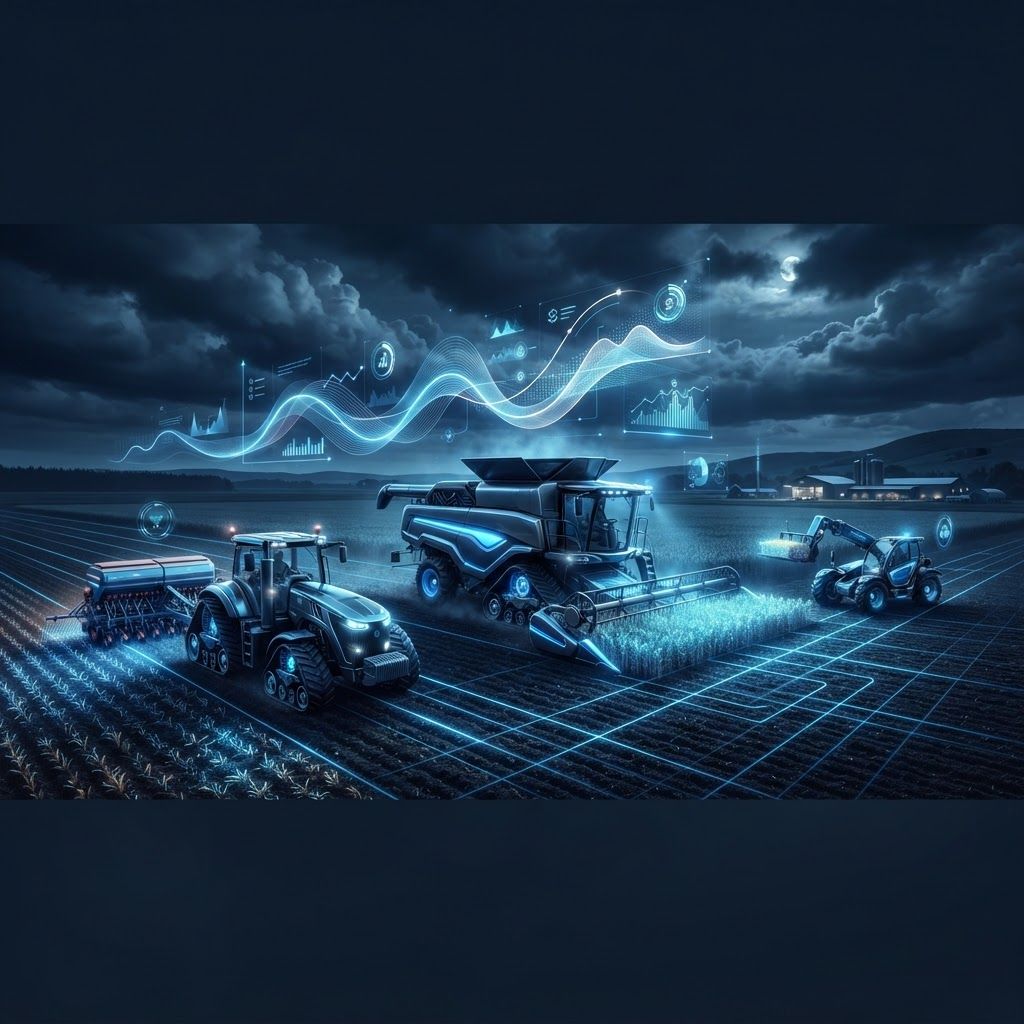
The greatest change in farm machinery over the past fifteen years has not been horsepower but data. GPS guidance with real-time kinematic correction allows steering accuracy within a few centimetres, eliminating overlap and reducing fuel, seed and chemical use. Variable rate application adjusts fertiliser and spray inputs according to soil and crop mapping, improving both economics and environmental performance.
Telematics now allow dealers to diagnose faults remotely, often dispatching an engineer with the correct part on the first visit. Isobus compatibility, which allows implements from different manufacturers to be controlled from a single terminal, has reduced cab clutter and simplified operation, although cross-brand implementation still varies in quality.
New, Used or Contracted
Not every farm should own every machine. For a typical dairy unit around Newcastle-under-Lyme, owning a tractor and loader makes obvious sense, while owning a self-propelled forage harvester almost never does. Contractors spread the capital cost of specialist equipment across many farms and bring trained operators, which is why contracting is so entrenched in the local silage and harvest calendar.
The used market is buoyant, and well-maintained machines from reputable dealers with full service history offer substantial savings over new. Buyers should weigh residual warranty, hours worked and the availability of software updates. Finance structures, including hire purchase, contract hire and lease, allow farms to match repayments to cash flow, and the tax treatment of each option is worth discussing with an accountant before committing.
Maintenance and Operator Skills
Machinery reliability depends as much on maintenance discipline as on brand choice. Scheduled servicing, correct tyre pressures, greasing regimes and winter storage practices extend working life significantly. Increasingly, farms are investing in operator training, both for safety and to ensure that expensive precision features are actually used rather than switched off.
Safety remains a serious concern. Agriculture has one of the highest fatal injury rates of any sector in the United Kingdom, with machinery, transport and livestock incidents predominating. Proper guarding, safe stop procedures and controlled access around working machinery are essential.
Sustainability in Farm Machinery
Manufacturers are investing heavily in reducing emissions. Latest engine stages have cut particulates and nitrogen oxides substantially, while alternative fuels including hydrotreated vegetable oil, biomethane and electric drivelines are moving from prototype to production for lighter machines. Reduced tillage equipment, which cuts fuel use and preserves soil structure, is gaining traction on the heavier land around the borough.
Final Thoughts
Farmers around Newcastle-under-Lyme have access to every major agricultural equipment brand through dealers across Staffordshire, Cheshire and Shropshire. The best purchasing decisions balance specification against realistic workload, prioritise dealer support and parts availability, and take full advantage of the precision features that increasingly separate profitable operations from merely busy ones.
Want your brand featured in front of decision-makers? Publish a guest post or get a link insertion in our guides through AAMAX's guest post and link insertion service.
Helpful Links
 SponsoredAAMAX — Full-Service Digital Agency
Write for Us
Share your expertise with our readers. We welcome guest contributions from industry specialists.
Pitch your idea

