

Why Ipswich Matters to Suffolk Agriculture
Suffolk is one of the most productive arable counties in the United Kingdom, with light, workable soils supporting cereals, sugar beet, oilseed rape, potatoes and an expanding range of horticultural crops. Ipswich functions as the commercial anchor for that farming economy. Dealerships, parts distributors, service workshops and machinery finance providers cluster in and around the town, giving growers across the county access to equipment without long journeys during critical windows.
Machinery decisions in this region carry unusual weight. Drilling and harvest windows in East Anglia can be narrow, and a breakdown at the wrong moment costs far more than the repair bill. That reality shapes how local farmers evaluate brands. Raw specification matters, but dealer backup, parts availability and software support frequently matter more.
Ten Agricultural Equipment Brands Trusted Around Ipswich
John Deere remains the benchmark for many arable operations. Its appeal is not only engine performance but the depth of its precision farming ecosystem, covering guidance, section control, telematics and data management. For larger farms running multiple machines, that integration reduces overlap, saves input costs and produces genuinely usable field records.
Case IH holds a strong following among Suffolk growers, particularly for high-horsepower tractors and combine harvesters. The brand's continuously variable transmissions and cab ergonomics are frequently praised by operators who spend very long days in the seat during harvest.
New Holland offers a broad range that suits both large arable units and smaller mixed farms. Its combines and balers have a solid reputation, and the brand has invested heavily in alternative fuel research, which appeals to farms planning for lower-carbon operations.
Massey Ferguson continues to be valued for straightforward, serviceable machinery. Many growers appreciate that mid-range Massey tractors deliver dependable performance without the complexity or cost of top-tier electronics, which suits operations that carry out much of their own maintenance.
Fendt occupies the premium end of the market. Higher purchase prices are offset for many by exceptional fuel efficiency, refined transmissions and strong residual values. On large contracting operations racking up substantial annual hours, the total cost of ownership argument often works in its favour.
Claas has a particularly strong presence in forage and harvesting equipment. Its combines, forage harvesters and balers are widely used across the region, and the brand's reputation for build quality in high-throughput conditions is well established.
Kubota dominates the compact and utility segment. Smallholdings, equestrian businesses, horticultural growers and groundcare operations around Ipswich rely on Kubota compact tractors and utility vehicles for their manoeuvrability, reliability and ease of operation.
Kverneland is a specialist in soil preparation, seeding and crop care implements. Ploughs, power harrows, seed drills and sprayers from the brand are common across Suffolk, where matching implement to soil type has a direct effect on establishment quality.
Amazone has built its name on precision fertiliser spreaders and sprayers. With input costs under continuous scrutiny and nutrient regulations tightening, accurate application equipment has moved from a nice-to-have to a core investment for many arable farms.
JCB supplies the telescopic handlers and loaders that underpin daily farm logistics. From loading grain trailers to stacking bales and handling fertiliser, telehandlers are among the hardest-working machines on any farm, and JCB's service network across the region is a significant practical advantage.
Technology Trends Reshaping Farm Machinery
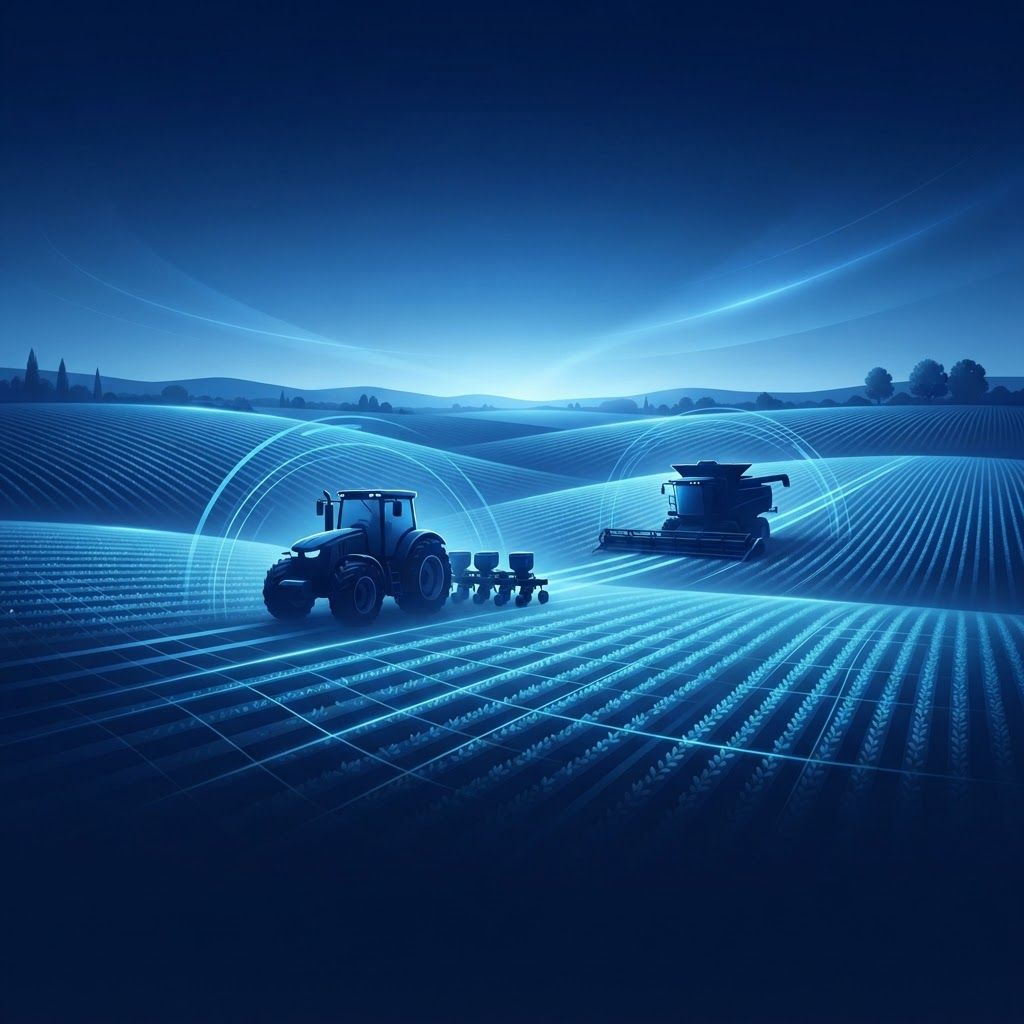
Precision agriculture has moved firmly into the mainstream. Satellite guidance with centimetre-level accuracy, automatic section control on sprayers and spreaders, and variable rate application driven by soil and yield mapping are now common on medium-sized Suffolk farms, not just the largest estates. The financial case is straightforward: reducing overlap cuts seed, fertiliser and fuel consumption while improving crop uniformity.
Telematics is another major shift. Machines now report location, fuel use, engine load and fault codes in real time, allowing dealers to diagnose problems remotely and arrive with the correct part. During harvest, that capability can convert a two-day outage into a two-hour one.
Autonomy and electrification are progressing more slowly but steadily. Small autonomous units for field scouting and light cultivation are being trialled, while battery-powered compact machinery is becoming viable for yard work and horticulture. Most Suffolk growers are watching these developments with interest rather than committing capital yet, which is a reasonable position given the pace of change.
Practical Buying Considerations
The most common mistake in machinery purchasing is over-specification. Buying more horsepower or a wider implement than the farm's acreage and field sizes justify ties up capital and increases running costs without improving output. Machinery should be sized to realistic workloads and to the physical constraints of local field layouts and road access.
Dealer support deserves careful scrutiny. Ask specific questions: what is the guaranteed response time during harvest, how many trained technicians cover the area, and what proportion of common parts are held locally rather than ordered centrally. A slightly less prestigious brand with outstanding local backup often outperforms a premium badge with a distant service centre.
Finance structure matters too. Contract hire, lease purchase and outright ownership each suit different cashflow profiles. Farms with variable income patterns often benefit from predictable monthly costs, while those with strong reserves may prefer to own and run machines for longer. Residual value projections should be part of the calculation, not an afterthought.
Finally, consider the used market seriously. Well-maintained pre-owned machinery with documented service history can deliver excellent value, particularly for implements where technology changes slowly. Ploughs, cultivators and trailers frequently offer better returns second-hand than new.
Final Thoughts
The agricultural equipment market around Ipswich is well served, with strong representation from global manufacturers and specialist implement makers alike. The right choice depends far less on brand loyalty than on honest assessment of farm size, soil type, labour availability and service requirements. Growers who define their operational needs clearly before visiting a dealership consistently make better investments, and in a region where weather windows dictate success, dependable machinery backed by responsive support remains the foundation of a profitable season.
Want your brand featured in front of decision-makers? Publish a guest post or get a link insertion in our guides through AAMAX's guest post and link insertion service.
Helpful Links
 SponsoredAAMAX — Full-Service Digital Agency
Write for Us
Share your expertise with our readers. We welcome guest contributions from industry specialists.
Pitch your idea

