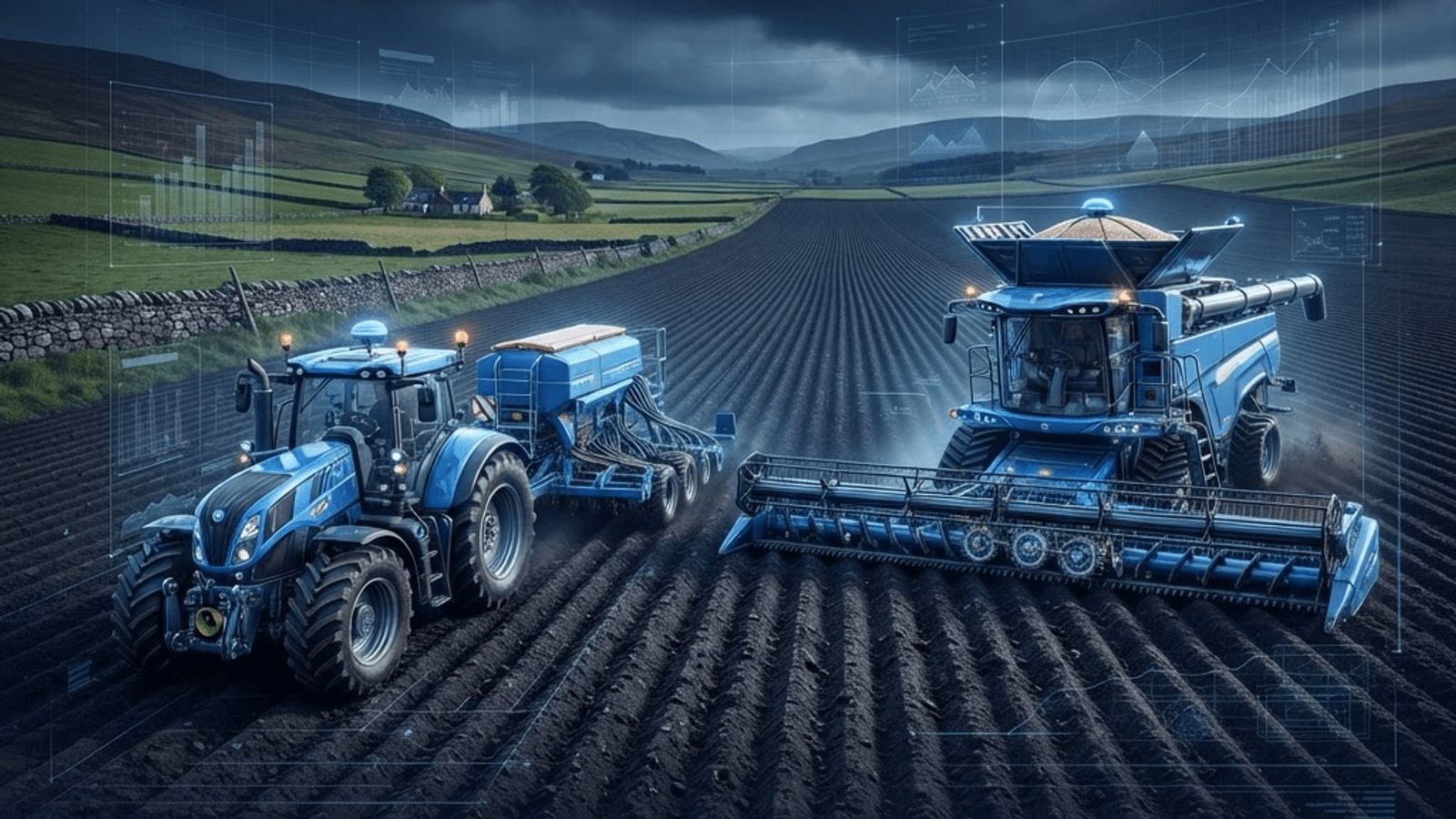
Machinery and the Modern Scottish Farm
Agricultural machinery represents the single largest capital commitment most farms make. A modern tractor with front loader, a self-propelled forage harvester or a precision drill can each cost more than a house, and the decision carries consequences for a decade or more. In the Forth Valley, where farms range from compact livestock units on higher ground to substantial arable operations on the carse, equipment choice must match genuinely varied conditions.
Falkirk farmers face a specific challenge: Scottish weather compresses field operations into narrow windows. When a dry spell arrives during a wet autumn, the ability to drill or harvest quickly determines whether a crop is established at all. This places a premium on machine capacity, reliability and, above all, local dealer support that can get a broken machine running the same day.
What Matters When Choosing Agricultural Equipment
Experienced farmers rarely choose on specification alone. Dealer proximity and parts availability frequently outrank horsepower figures, because downtime during harvest is far more expensive than a slightly higher purchase price. Resale value matters greatly, since machinery is often traded within five to seven years. Fuel efficiency has grown in importance as diesel costs have risen. Compatibility with existing implements, hydraulic capacity, linkage categories and increasingly the ability to integrate with farm software all influence the decision.
For grassland and livestock farms, manoeuvrability and loader performance often matter more than raw power. For arable operations, working width, tyre and track options for soil protection, and precision guidance capability tend to dominate. Contractors need durability above all, since their machines accumulate hours at several times the rate of a typical farm unit.
Ten Leading Agricultural Equipment Brands and Dealers Serving Falkirk
1. John Deere — Globally dominant and widely represented across central Scotland, John Deere's appeal rests on strong dealer networks, sophisticated precision farming integration and exceptional resale values. Their guidance and telematics systems are among the most mature available, and the extensive parts infrastructure reduces downtime risk considerably.
2. New Holland — A long-standing favourite on Scottish farms, particularly for combine harvesters and mid-range tractors. New Holland machines have a reputation for operator comfort and straightforward serviceability, and their grassland equipment suits the mixed farming common around Denny and Slamannan.
3. Massey Ferguson — Valued for dependable, no-nonsense engineering at accessible price points. Massey tractors remain popular on family farms where simplicity and ease of repair are prized over maximum technological sophistication, and older models hold value remarkably well.
4. Case IH — Strong in higher-horsepower arable machinery, with well-regarded combines and powerful tractors suited to the larger carse-land operations. Their continuously variable transmissions and cab ergonomics receive consistent praise from operators spending long days in the seat.
5. Fendt — A premium German brand with a reputation for engineering refinement, fuel efficiency and advanced transmissions. The purchase price is high, but operators report lower running costs and exceptional longevity, making Fendt a favourite among contractors accumulating high annual hours.
6. Claas — Particularly strong in forage harvesting, balers and grassland equipment, which suits the significant silage-making activity across the Forth Valley. Their forage harvesters are widely used by contractors, and their combine range performs well in the variable crop conditions Scotland presents.
7. Kubota — Dominant in the compact and mid-range segment, ideal for smallholdings, equestrian businesses, horticultural operations and grounds maintenance. Their compact tractors and utility vehicles handle the tight spaces and lighter tasks where a full-size machine would be impractical.
8. Kverneland — Specialists in soil cultivation, seeding and crop protection implements. Their ploughs, power harrows and precision drills are well suited to the heavier carse soils, and their variable-rate seeding technology supports the precision agriculture practices increasingly adopted locally.
9. Krone — Focused on grassland and forage machinery including mowers, tedders, rakes and balers. For livestock farms whose profitability depends heavily on forage quality, Krone's build quality and clean cutting performance justify their reputation among grassland specialists.
10. JCB — British-built and ubiquitous on farms for telescopic handlers and loadalls, which have become almost as essential as tractors for handling bales, feed, muck and materials. Their agricultural telehandlers combine lift capacity with the visibility and manoeuvrability that yard work demands.
Technology Reshaping Farm Machinery
Precision guidance has become standard rather than exceptional. RTK-corrected GPS steering reduces overlap, saves fuel and seed, and reduces operator fatigue during long days. On fields with irregular boundaries, which describes much of the Forth Valley, the savings are meaningful.
Telematics and data integration now connect machines to farm management software, logging field operations, fuel use and yield automatically. This removes a great deal of paperwork and generates the records increasingly required for assurance schemes and carbon reporting.
Soil protection has become a design priority. Controlled traffic farming, low-pressure tyre systems and tracked options reduce compaction, which is a persistent problem on heavy Scottish soils worked in marginal conditions. Compaction damage suppresses yields for years, so machinery choices that limit it pay back slowly but reliably.
Alternative power sources are beginning to appear. Electric compact tractors, methane-fuelled prototypes and hybrid systems all exist, though for high-power field operations diesel remains dominant for now. Farms with anaerobic digestion or substantial renewable generation are watching these developments with particular interest.
Practical Buying Advice
Before committing, arrange a genuine on-farm demonstration in your own conditions rather than relying on a show-ground impression. Ask about guaranteed parts availability windows and typical response times for breakdown callouts during harvest. Consider whether a slightly older, lower-hour used machine from a well-supported brand offers better value than a new entry-level model.
Contracting deserves honest consideration too. For operations performed only a few days each year, hiring a contractor with modern, high-capacity equipment often costs less than owning a machine that depreciates in a shed for eleven months. Many Falkirk farms have found the optimal position is owning core tractors and loaders while contracting out specialist operations like forage harvesting and combining.
Want your brand featured in front of decision-makers? Publish a guest post or get a link insertion in our guides through AAMAX's guest post and link insertion service.
Helpful Links
 SponsoredAAMAX — Full-Service Digital Agency
Write for Us
Share your expertise with our readers. We welcome guest contributions from industry specialists.
Pitch your idea