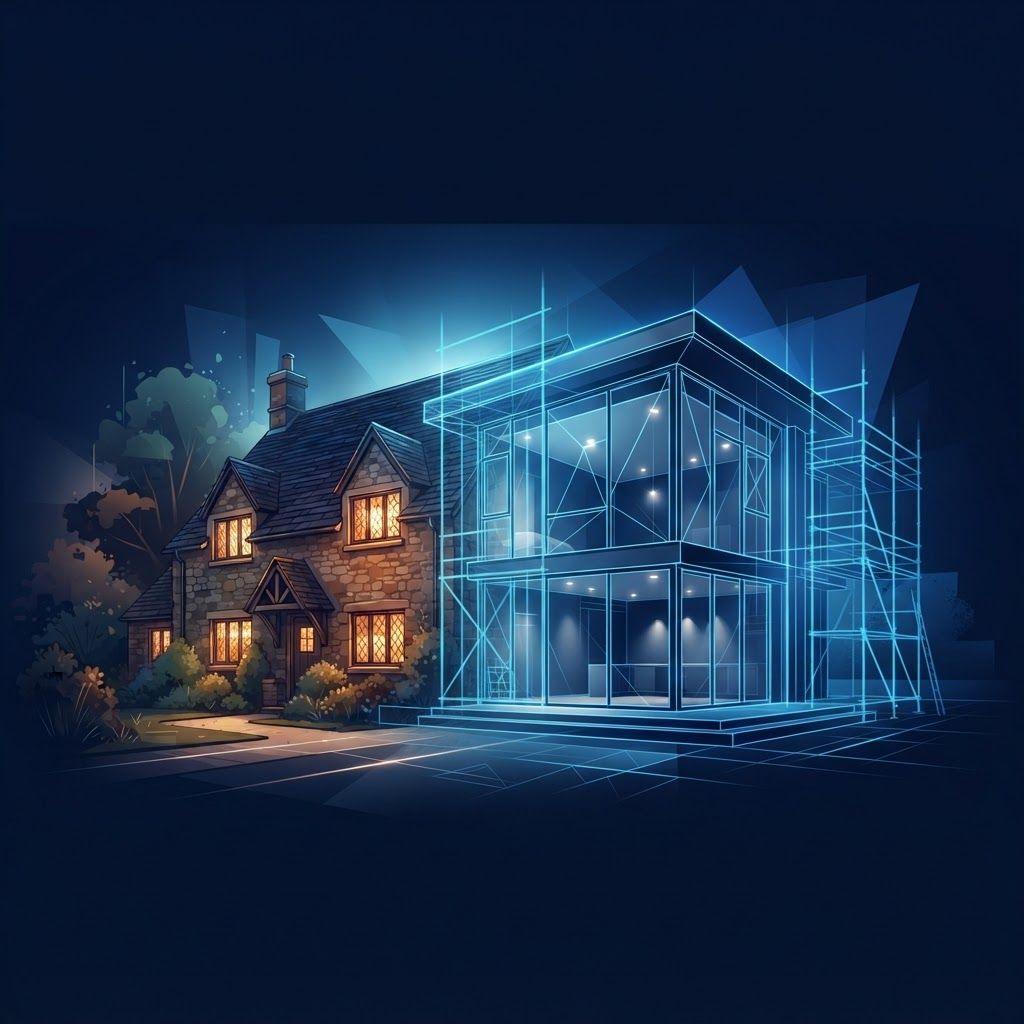
Why Renovation Dominates in East Hampshire
East Hampshire has a housing stock notably older and more varied than the national average. Timber-framed cottages, Georgian townhouses in Petersfield and Alton, Victorian terraces, Edwardian villas, interwar semis and substantial numbers of 1960s and 1970s houses all sit alongside newer development. With planning policy restricting new building across much of the district, the natural response to needing more space or better performance is to improve what already exists.
Renovation also makes economic sense. Extending and upgrading an existing home in a desirable village frequently costs less than moving, particularly once stamp duty, agency fees and the difficulty of finding a suitable property are accounted for. The result is a large and sophisticated renovation market with specialists covering everything from routine extensions to complete restoration of listed buildings.
The Range of Renovation Work
Extensions remain the most common project type. Single-storey rear extensions, side returns, two-storey side extensions and wrap-around designs each carry different structural and planning implications. Many fall under permitted development rights, though these are significantly curtailed within the South Downs National Park, in conservation areas and for listed buildings, which cover a substantial portion of the district.
Loft conversions offer excellent value where roof geometry permits, converting unused volume into bedrooms and bathrooms. Feasibility depends on head height, roof structure, staircase position and fire escape requirements, all of which a competent contractor assesses at the outset.
Internal reconfiguration has become increasingly popular, opening up compartmented older layouts into connected living spaces. This requires structural steelwork and careful attention to load paths, and in older buildings frequently reveals inadequate existing foundations or timber decay.
Whole-house refurbishment addresses everything at once: rewiring, replumbing, new heating, insulation, windows, kitchen, bathrooms and finishes. It is disruptive and usually requires the house to be vacated, but it is by far the most efficient way to bring an older property up to modern standards because every element can be coordinated.
Heritage renovation is a specialism of its own. Listed buildings require listed building consent for works affecting character, including internal alterations. Traditional buildings constructed with solid walls and lime mortars need to breathe, and applying modern impermeable materials such as cement render or gypsum plaster traps moisture and causes decay. Specialists in this field use lime plasters and mortars, breathable insulation such as wood fibre, and traditional joinery repair techniques.
What the Best Renovation Contractors Do Differently
Thorough pre-start investigation is the first hallmark. Renovation carries far more uncertainty than new build because much of the existing structure is concealed. Good contractors open up sample areas before finalising price, check foundation depths where extensions will connect, assess timber for rot and beetle infestation, verify the condition of existing drainage, test for asbestos in properties built before 2000, and establish whether the existing electrical installation and consumer unit can support the intended work.
Honest contingency planning follows. Experienced renovators tell clients plainly that a contingency of fifteen to twenty per cent is appropriate for older properties, because discoveries are the norm rather than the exception. A contractor who prices a Victorian refurbishment with no contingency discussion is either inexperienced or is planning to recover the difference through variations later.
Understanding of traditional construction distinguishes the best from the merely competent. A contractor who knows why a solid wall should not be internally insulated with impermeable foam, why a damp problem is more often a failed gutter or raised external ground level than rising damp, and why replacing lime mortar with cement causes spalling in soft bricks will produce a durable result. Many damp problems in the district's older housing stock were created by well-intentioned but inappropriate previous work.
Programme and disruption management matters greatly when clients remain in occupation. Dust screening, temporary kitchen arrangements, protection of floors and furniture, daily clean-down and clear communication about noisy work make an enormous difference to the experience.
Finally, quality of finishing carpentry and decoration is where renovation projects are ultimately judged. Aligning new work with old, matching mouldings and skirting profiles, achieving level floors in a building that has moved over two centuries, and making new joinery look as though it belongs are skills that separate genuine craftspeople from general builders.
Energy Upgrades in Older Buildings
Improving the thermal performance of older homes is one of the most requested renovation objectives and one of the most technically delicate. The correct sequence begins with the simplest measures: draught-proofing, loft insulation, and improving heating controls. These deliver the best return per pound and carry essentially no moisture risk.
Solid wall insulation, whether internal or external, requires far more care. It changes the thermal and moisture behaviour of the wall, potentially moving the dew point into the structure and causing interstitial condensation. Breathable systems such as wood fibre with lime finishes manage this properly. External insulation alters appearance and is generally unacceptable on the front of a period property in a conservation area.
Window upgrades present a similar tension. Original single-glazed sash windows are often a defining character feature and, in listed buildings, replacement is usually refused. Solutions include careful draught-proofing and overhaul of existing sashes, secondary glazing, which is highly effective acoustically as well as thermally, or slim-profile double glazing within refurbished frames where consent allows.
Heating system replacement has shifted toward heat pumps, but retrofitting one into a poorly insulated period property without first improving fabric and emitter sizing produces disappointing results and high running costs. Good contractors insist on doing these in the right order.
Planning, Consents and Party Walls
Check early whether permitted development applies, and never assume it does within the National Park or a conservation area. Building regulations approval is required for structural work, new drainage, electrical work, heating installations, insulation upgrades and window replacement, regardless of whether planning permission is needed.
Party wall notices must be served where work affects a shared wall, involves excavation near a neighbouring foundation, or includes building at the boundary line. Notice periods run to one or two months depending on the work, so this needs to begin early.
For listed buildings, unauthorised works are a criminal offence, not merely a planning breach. Contractors experienced in heritage work will not proceed without consent in place.
Choosing Well
Look for contractors with a portfolio of properties similar in age and construction to yours. Visit completed projects. Ask how they handled the unexpected discoveries that inevitably arose and whether the client felt informed throughout.
Use a written contract even for modest works, with a clear specification, an agreed payment schedule tied to progress, and a defined process for variations. Retain a percentage until defects are made good.
Improving What Already Exists
Renovation is the most sustainable form of construction, reusing embodied carbon already invested in a building and keeping character in the landscape. The contractors who do it best in East Hampshire combine modern technical knowledge with real respect for how older buildings were designed to behave.
Want your brand featured in front of decision-makers? Publish a guest post or get a link insertion in our guides through AAMAX's guest post and link insertion service.
Helpful Links
 SponsoredAAMAX — Full-Service Digital Agency
Write for Us
Share your expertise with our readers. We welcome guest contributions from industry specialists.
Pitch your idea